
Intrapreneurship
Intrapreneurship program for employees
- Tailored after a scoping call
- In person or remote
- Ideas to tested ventures
- Built around real opportunities
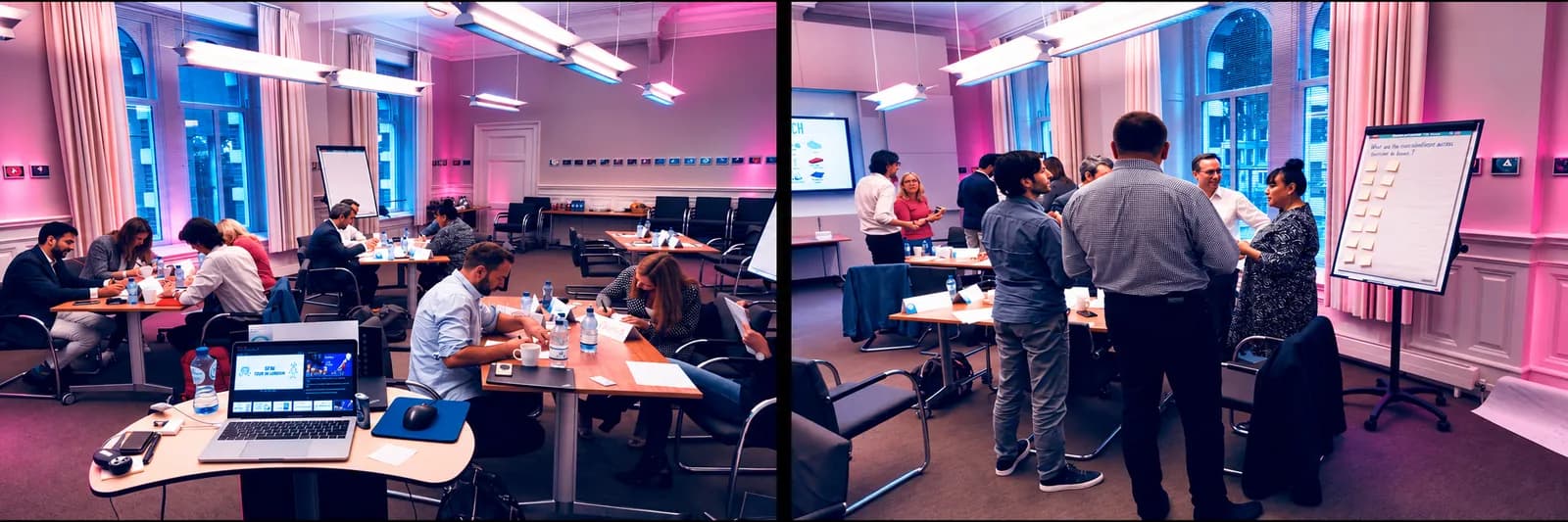
Most organisations have people who see better ways of doing things. They notice the customer complaint that keeps coming back, the process that wastes hours every week, the product gap a competitor has not filled yet. What they usually lack is not ideas. It is a method for testing an idea cheaply, a sponsor who will make a decision on the evidence, and permission to spend some time on it. An intrapreneurship program gives employees those three things.
Collective Campus has been building this capability with Australian teams since 2015. An intrapreneurship program, in the way Collective Campus runs it, is capability building for the people already inside the organisation. Participants learn the methods startups use to reduce risk, apply them to a live problem or opportunity, and bring a sponsor evidence that supports a decision to continue, change or stop. The methods come from lean startup and product sprints, design thinking and, where it helps, AI design sprints for rapid prototyping. The focus is on the skills that stay with people long after the program ends.
Quick answer
An intrapreneurship program teaches employees to find, test and develop new ideas inside their organisation using startup methods such as problem interviews, assumption mapping, cheap prototypes and experiments. The best programs work on real problems, give each team an executive sponsor with the power to decide, protect some time for the work and judge ideas on evidence rather than pitch polish. Collective Campus designs intrapreneurship programs as capability building for teams, tailored after a scoping call, with no fixed format, length or group size, and does not publish prices.
What intrapreneurship actually means
The word intrapreneur describes an employee who behaves like an entrepreneur inside an existing organisation. That can sound grand, as though every intrapreneur should be launching a new business unit. In practice the most useful definition is much more modest. An intrapreneur is an employee with a live problem, a sponsor and permission to run a test.
The idea does not need to become a standalone company. It might be a new service for an existing customer group, a change to how a product is sold, a better internal process, a new channel, a partnership or a pilot. What makes it intrapreneurial is the way the work is done: starting from a problem, treating the solution as a set of assumptions, testing the riskiest ones cheaply and letting the evidence shape the next step.
This distinction matters because many organisations confuse intrapreneurship with idea collection. They run an ideas portal or a pitch competition, gather hundreds of suggestions, choose a handful of winners and then discover that nothing much happens next. The ideas were never tested, nobody owned the decision and the people who suggested them went back to their day jobs. Intrapreneurship is not about having ideas. It is about the discipline of turning an uncertain idea into evidence.
Why organisations run intrapreneurship programs
Organisations come to intrapreneurship for different reasons, and the reason shapes the design.
- Growth. Leaders want new revenue, new customers or new offers, and they know the core business will not deliver all of it.
- Customer problems. There are known pain points in the customer experience that nobody has the time or mandate to solve.
- Efficiency. Processes are slow, costly or frustrating, and frontline staff can see better ways of working.
- Capability. The organisation wants more people who can work with uncertainty, test before investing and make decisions on evidence.
- Engagement and retention. Ambitious employees want to contribute beyond their job description, and the organisation wants to keep them.
- Culture. Leaders want to shift from a culture of approval and certainty towards one of learning and experimentation.
- AI adoption. Teams want to explore where AI can change a service or process, and need a safe, structured way to test those ideas.
A good program can serve several of these aims, but it helps to be honest about which one matters most. A program designed mainly for engagement looks different from one designed to produce a new revenue stream. The scoping call is where that choice is made.
The core methods
Intrapreneurship programs draw on a small set of well-tested methods. The lean startup principles of build, measure, learn sit at the centre, supported by tools from design thinking and business model design.
Problem framing. Teams start by defining the problem precisely: who has it, how often, how painful it is and how people solve it today. A well-framed problem is half the work, and many ideas change shape at this stage.
Customer discovery. Teams speak with real customers or users, using interview techniques that avoid leading questions and focus on past behaviour rather than opinions about the future. This is often the most eye-opening part of a program.
Value proposition design. Teams describe the jobs, pains and gains of the customer and how a solution would address them. Tools such as the value proposition canvas make this concrete and easy to share.
Assumption mapping. Every idea rests on assumptions about desirability (do customers want it), viability (does it make commercial sense) and feasibility (can the organisation deliver it). Teams list these assumptions and identify the riskiest ones to test first.
Experiment design. Teams design small, cheap experiments to test those assumptions: landing pages, advertisements, concierge tests where the service is delivered manually, expressions of interest, mock-ups, pilots with a handful of customers. Each experiment has a clear hypothesis and success threshold set in advance.
Prototyping. Teams build the simplest version of the idea that will produce useful learning. With AI tools, prototypes that once took weeks can often be produced much faster, which lets teams test more ideas.
Evidence and decision. Teams present what they learned, not just what they believe, and sponsors decide to continue, change direction or stop. Stopping an idea early, on evidence, is a success, not a failure.
The sponsor makes the program real
The single biggest predictor of whether an intrapreneurship program produces anything is the role of the sponsor. A sponsor is a senior leader who names the decision the team is working towards, protects time for the work, removes obstacles and agrees in advance to make a call when the evidence is in.
Without a sponsor, intrapreneurs collect sticky notes, build a pitch deck and return to the day job. With a sponsor, the work has a destination. Collective Campus writes the sponsor's role into the scoping call. If nobody can say yes or no to the work, the organisation does not yet have a program. It has an exhibition. Getting to a named sponsor is a legitimate outcome of the first conversation.
Sponsors also need some support. Many senior leaders are used to judging business cases, which ask for certainty. Intrapreneurship asks them to judge evidence from small experiments, which is a different skill. Programs usually include a short briefing for sponsors on how to read experiment results, what good questions to ask and how to avoid killing promising ideas too early or keeping weak ones alive too long.
How an intrapreneurship program can be structured
There is no single structure, and every program is tailored after a scoping call. The building blocks usually include:
- Leadership alignment. A session with sponsors and senior leaders to agree the purpose, the problem areas, decision rights and how success will be judged.
- Challenge definition. Choosing the problems or opportunity areas teams will work on. Programs work best when challenges are linked to strategy rather than left completely open.
- Team formation. Building cross-functional teams that combine customer knowledge, operational knowledge and technical knowledge.
- Capability workshops. Hands-on sessions on problem framing, customer discovery, assumption mapping, experiment design and prototyping, applied immediately to each team's challenge.
- Experiment cycles. Teams run experiments in the real world, with coaching between sessions.
- Coaching. Regular check-ins where coaches help teams design better experiments, interpret results and decide what to do next.
- Evidence reviews. Sessions where teams present what they have learned to sponsors and receive decisions.
- Handover. For ideas that continue, a clear path into the business, whether that is a product team, a pilot budget or a business unit.
Some organisations run a single cohort around one strategic challenge. Others run an ongoing program with regular cohorts. Some start with a focused sprint to prove the approach before committing to anything larger. The right shape depends on the organisation's aims, appetite and capacity.
Real examples from Collective Campus work
The published case studies on the Collective Campus site show the pattern in practice.
Australian Unity. A cross-functional group from Australian Unity used lean startup methods to test the assumptions behind a number of private health insurance policy ideas. Participants learned to use the lean canvas to define problem, solution and customer segment, identify key assumptions, set metrics and build prototypes such as advertisements and landing pages. The teams ran more than 26 online and customer-facing experiments across four ideas, including social media advertisements, search advertising, landing pages and face-to-face customer interviews in the Melbourne CBD. The result was quantitative and qualitative learning that could be used to build internal support for the ideas.
AGL. AGL's lean startup work focused on problem interviews, offer tests and kill criteria that risk and retail teams could live with. In a regulated energy retailer, compliance is a design input from the start, and concierge, scripted and expression-of-interest tests can produce learning long before any change to core systems. The outputs were hypotheses with owners and a clear basis for stopping ideas that did not hold up.
M3 Property. At M3 Property, an AI design sprint produced 20 ideas, eight pitches and two winning concepts. The format showed how quickly a team can move from problem to tested concept when AI is used for prototyping.
These examples share a common thread: real people from inside the business, a real problem, cheap tests, contact with customers and a result that could support or retire a business case.
Intrapreneurship in regulated industries
Many Australian organisations work in regulated environments: financial services, insurance, energy, health, legal services and government. Leaders in these sectors sometimes assume startup methods are too risky to use. In practice, the methods are especially useful in regulated settings, because they reduce the risk of investing in something customers do not want or that cannot be delivered within the rules.
The key is to bring risk, compliance and legal colleagues in early, treat their requirements as design inputs and choose experiments that do not expose customers to harm. Tests that use mock-ups, interviews, expressions of interest, manual delivery to a small group or internal pilots can all produce useful evidence without touching regulated products. Teams learn to ask "what is the thinnest experiment risk can live with?" rather than "how do we get around risk?"
Intrapreneurship in government and not-for-profits
Public sector and not-for-profit organisations also run intrapreneurship programs, though the language often changes. Instead of revenue, the focus is on outcomes for citizens, members or clients, on service improvements and on doing more with limited budgets. The methods are the same: frame the problem, speak with the people affected, test the riskiest assumptions cheaply and decide on evidence. Public sector teams often find that experiments help them build the evidence base that funding and policy decisions require.
Where intrapreneurship programs go wrong
Many intrapreneurship programs start with enthusiasm and fade within a year. The common causes are well known.
- Ideas without problems. Teams fall in love with solutions before understanding the problem, and spend their time defending ideas rather than testing them.
- No sponsor or no decision. Teams produce evidence but nobody has the authority or willingness to act on it.
- No time. Participants are expected to do the work on top of a full job, and it quietly gets dropped.
- Pitch theatre. Programs reward polished presentations rather than evidence, so teams optimise for applause.
- Open-ended challenges. Without a link to strategy, ideas scatter in every direction and few find a home.
- No path into the business. Promising ideas have nowhere to go once the program ends.
- Measuring the wrong things. Counting ideas submitted rather than assumptions tested, decisions made or capability built.
- Punishing failure. If stopping an idea is seen as failure, teams hide bad news and keep weak ideas alive.
- One-off events. A single hackathon creates energy but rarely changes how the organisation works.
Collective Campus designs programs to avoid these traps, starting with the scoping call and continuing through sponsor briefings, evidence-based reviews and a clear handover path.
Who should take part
Intrapreneurship is not only for people with "innovation" in their title. The best participants are often people close to customers or operations who see problems first. Programs usually include a mix of:
- Frontline and customer-facing staff who know where the experience breaks.
- Operational specialists who understand how the work really gets done.
- Product, marketing and digital teams who can design and run experiments.
- Finance, risk and legal colleagues who can test viability and keep experiments safe.
- Emerging leaders developing their ability to lead through uncertainty.
- Senior sponsors who make decisions and remove obstacles.
Cross-functional teams tend to produce better evidence, because each person sees different risks and opportunities.
Building intrapreneurship as a lasting capability
The ideas from any single program matter, but the lasting value is in the people. Participants who have run a real experiment, spoken with real customers and presented evidence to a sponsor bring those habits back to their everyday work. They ask better questions, test before investing and are more comfortable with uncertainty.
To build this as a lasting capability, organisations can:
- Train internal coaches who can support future cohorts.
- Create simple templates for problem statements, assumption maps and experiment cards.
- Make small experiment budgets easy to access without a full business case.
- Recognise people for learning and good decisions, not just successful launches.
- Share what was learned from stopped ideas as openly as from successful ones.
- Link intrapreneurship to the strategy and planning cycle so promising ideas get funded.
This is the difference between an innovation event and a capability. An event produces a list of ideas. A capability produces people who can keep finding and testing ideas long after the program ends.
How AI changes intrapreneurship
AI tools have changed the economics of experimentation. Tasks that once took days, such as drafting a landing page, producing a prototype interface, summarising interview notes or modelling a simple business case, can now be done much faster. That means teams can test more ideas, more cheaply, in less time.
AI also brings new risks. Teams can produce polished prototypes that hide untested assumptions, or rely on AI-generated research rather than speaking to real customers. Programs teach teams to use AI to speed up the build and analysis steps while keeping the most important step, contact with real customers, firmly human. Where privacy or data concerns apply, teams learn which tools and data are appropriate to use.
Intrapreneurship and the wider innovation capability
Intrapreneurship is one part of a broader capability. Organisations that want to build innovation capability across many teams, not just a selected cohort, can look at innovation capability building more broadly. Some organisations also combine intrapreneurship with startup engagement, where internal teams work alongside external startups on shared problems. Each approach suits different goals, and they often work best in combination.
Formats (shaped after a scoping call)
Every program is tailored after a scoping call, so there is no fixed length, headcount or package. What changes from one organisation to the next is the mix of the elements below, chosen to fit the outcome the team needs and the real constraints on its time.
- Focused workshop. A single facilitated session built around one live problem the team brings into the room. Best when the goal is a shared language, a quick diagnosis and a small number of agreed next steps.
- Workshop series. A sequence of shorter sessions spaced out so people apply each idea at work between sessions and bring back what happened. Best when the goal is behaviour change rather than awareness.
- Applied program. Training combined with a real piece of work: a service, process or team challenge the group moves forward while learning. Best when leaders want a visible result, not just a completion record.
- Leadership session plus team rollout. Leaders go first so they can model the behaviour and remove blockers, and then teams follow with sessions that reflect what leaders agreed.
- Coaching and follow-up. Check-ins, clinics or office hours after the formal sessions so teams get help when they hit the hard part of applying the method.
- In person, remote or hybrid. Delivered on site in Sydney, Melbourne, Brisbane and other Australian cities, or live online for distributed teams. Remote sessions are designed for remote work rather than a slide deck streamed over video.
The scoping call covers who is in the room, what is already in place, what success looks like in practical terms and what would get in the way. The design follows from those answers.
What participants and organisations leave with
- A tested idea with clear evidence about whether it is worth pursuing.
- A precise problem statement grounded in real customer conversations.
- An assumption map showing what is known, what is believed and what is still risky.
- Experiment results with hypotheses, thresholds and outcomes recorded.
- A sponsor decision to continue, change direction or stop, made on evidence.
- Practical skills in customer discovery, prototyping and experiment design that transfer to everyday work.
- Templates and tools the organisation can reuse with future cohorts.
- A clearer view of what the organisation needs to change to support intrapreneurs over time.
How to tell whether it worked
Agree a few practical measures before the program starts, so success is judged on evidence rather than on how the session felt. Useful measures for this topic include:
- Assumptions tested. The number of key assumptions tested with real evidence, not just discussed.
- Customer conversations. How many real customer or user interviews teams completed.
- Experiments run. The number and quality of experiments designed and run, with thresholds set in advance.
- Decisions made. How many ideas reached a clear sponsor decision to continue, change or stop.
- Time to decision. How quickly ideas move from first concept to an evidence-based decision.
- Ideas progressed. Ideas that move into pilots, products or business units after the program.
- Capability uptake. Whether participants use the methods in later work, checked through follow-up.
- Sponsor confidence. Sponsor feedback on the quality of evidence and decisions.
Why capability building beats one-off training
Most training fails for a simple reason: people learn something in a room, return to a full inbox and an unchanged system, and within a few weeks behaviour drifts back to where it started. The research on learning transfer has said this for decades. What predicts whether learning sticks is less about the quality of the session and more about what happens around it: whether leaders expect and reinforce the new behaviour, whether people get to apply it immediately on real work, and whether the system they work in makes the new way easier rather than harder.
Collective Campus designs for transfer from the start. That means working on live problems rather than case studies from other companies, involving leaders so they can reinforce the change, building in practice and follow-up between sessions, and agreeing practical measures upfront. It also means being honest when training is not the answer. Sometimes the real blocker is a policy, an incentive or a system, and the most useful thing a scoping call can do is name it.
The difference shows up in what teams say afterwards. A one-off session produces "that was interesting." A capability building program produces "this is how we work now," along with the evidence of a changed process, a fixed journey or a decision made differently.
Comparing provider types
Intrapreneurship support comes from several kinds of provider. The comparison below describes provider types, not individual firms.
- Capability building provider such as Collective Campus. Typically strong at: Hands-on programs on live problems with sponsors, coaching and evidence reviews. Watch out for: Requires leaders to sponsor and protect time. Best fit when: You want employees to build lasting skills while testing real ideas.
- Large consultancy. Typically strong at: Strategy, venture building and large-scale innovation programs. Watch out for: Can be costly and may leave limited capability behind. Best fit when: You want an external team to build a venture for you.
- University or short course. Typically strong at: Structured learning and credentials for individuals. Watch out for: Often separated from live problems and sponsors. Best fit when: You want individuals to gain a qualification.
- Cross-organisation academy or network. Typically strong at: Peer learning with intrapreneurs from other organisations. Watch out for: Less tailored to one organisation's strategy and decisions. Best fit when: You want to connect a few intrapreneurs with a wider community.
- Hackathon or event company. Typically strong at: Energy, ideas and visible activity. Watch out for: Rarely produces tested evidence or lasting change. Best fit when: The goal is engagement and awareness.
Decision checklist: choosing a provider
Use these questions when comparing providers. A strong provider will answer most of them clearly before any proposal is written.
- Is the program linked to a clear strategic purpose?
- Will every team have a sponsor with authority to decide?
- How much time will participants really have for the work?
- Will teams work on real problems rather than hypothetical ones?
- Does the design require contact with real customers?
- How will ideas be judged: on evidence or on pitch polish?
- How are risk, legal and compliance colleagues involved?
- Is there a clear path into the business for ideas that continue?
- How will stopping an idea be treated?
- Will the organisation be able to run future cohorts itself?
- Can the provider show real, relevant case studies?
- Is the program tailored after a scoping call rather than sold off the shelf?
How Collective Campus scopes and runs a program
Collective Campus has been running capability building programs for teams in large organisations since 2015. The approach is the same whatever the topic.
- Scoping call. A conversation with the sponsor, and often with a few people from the team, about the outcome, the context and the constraints. Nothing is proposed before this call, because a generic proposal would be guessing.
- Discovery. Where it helps, short interviews or a brief survey with participants so the content reflects their real work and the language they use.
- Design. Content, exercises and examples are built around the team's own situations. Generic case studies are kept to a minimum; the team's live work is the main material.
- Delivery. Highly practical, facilitated sessions where most of the time is spent doing rather than listening. Participants leave with things they made, not just notes.
- Application. Agreed actions, owners and a simple way to check progress, so the work continues after the facilitators leave.
- Review. A debrief with the sponsor on what changed, what got stuck and what the team needs next.
Pricing, format and timing are all discussed after the scoping call, once both sides understand what the work actually involves.
Preparing for a program
A little preparation makes a large difference to the result.
- Name a sponsor. Someone senior enough to remove blockers and to ask about progress afterwards.
- Pick real work. Bring a live problem, journey, project or decision the team actually needs to move. Abstract exercises produce abstract results.
- Tell participants why. People engage more when they know why they are there and what will be different afterwards.
- Protect the time. Sessions interrupted by email and calls produce half the value. Agree that the time is protected.
- Plan the week after. Book the first follow-up action before the program starts, so momentum is not lost.
- Gather what already exists. Data, feedback, previous reviews and earlier attempts all help tailor the content.
Key terms
- Intrapreneur: An employee who uses entrepreneurial methods to develop new ideas inside an existing organisation.
- Intrapreneurship program: A structured program that gives employees methods, time and sponsorship to test new ideas.
- Sponsor: A senior leader who protects time for a team and makes decisions on the evidence it produces.
- Lean startup: An approach to building new products and services through rapid cycles of build, measure and learn.
- Minimum viable product: The simplest version of an idea that produces useful learning.
- Assumption mapping: Listing the beliefs an idea depends on and ranking them by risk and uncertainty.
- Concierge test: An experiment where the service is delivered manually to a few customers before anything is built.
- Value proposition canvas: A tool for matching customer jobs, pains and gains to a product or service.
- Lean canvas: A one-page business model template for new ideas.
- Kill criteria: Conditions agreed in advance that, if met, mean an idea should stop.
- Pivot: A change of direction based on what experiments have revealed.
- Customer discovery: Structured conversations to understand customer problems and behaviour.
- Innovation theatre: Activity that looks like innovation but produces little evidence or change.
Choosing challenges that matter
The challenges teams work on shape everything that follows. Completely open challenges, such as "bring us your best idea," produce a wide spread of suggestions that rarely connect to strategy. Very narrow challenges can feel like assigned projects and leave no room for discovery. The most productive challenges sit in between: a clear problem area linked to strategy, with freedom for teams to define the specific problem and solution.
Good challenge statements usually name a customer group, a problem or opportunity and why it matters now. For example, a challenge might focus on why a particular group of customers leaves in its first year, how a slow internal process could be made faster, or how a service could reach a group it does not serve well today. Sponsors help choose challenges, which builds their commitment to acting on the results.
Making time for intrapreneurs
Time is the scarcest resource in most intrapreneurship programs. If participants are expected to do the work in the gaps of a full job, the experiments rarely happen. Organisations handle this in several ways: protecting a regular slice of time each week, reducing other commitments for the period of the program, running focused sprints where teams work together intensively, or giving teams a small budget to buy help. Whatever the approach, the time commitment is agreed with managers and sponsors at the start, not left to individuals to negotiate.
The role of managers
Line managers are often overlooked in intrapreneurship programs, yet they determine whether participants can actually take part. A manager who sees the program as a distraction will quietly pull people back into business as usual. Programs work better when managers are briefed early, understand what their team member is working on and see how the skills will benefit their own team. Some organisations invite managers to evidence reviews, so they see the value first hand.
Questions for leaders to discuss before starting
- What do we most want from an intrapreneurship program: growth, customer improvement, efficiency, capability or culture?
- Which strategic problems or opportunities are we willing to let teams explore?
- Who will sponsor each team, and are they prepared to make decisions on evidence?
- How much time can participants realistically commit?
- What happens to ideas that succeed, and who funds the next step?
- How will we treat ideas that are stopped, and the people who worked on them?
- How will we know, a year from now, whether the program built lasting capability?
A clear answer to each of these questions makes the difference between a program that produces a list of ideas and one that produces evidence, decisions and people who keep working this way.
Talk to Collective Campus
If the organisation has people with ideas and problems worth solving, an intrapreneurship program can turn that potential into evidence and capability. Start with a short scoping call to discuss the purpose, sponsors and challenges. Book a scoping call.
Frequently asked questions
- What is an intrapreneurship program?
- It is a structured program that teaches employees startup methods such as customer discovery, assumption testing and prototyping, and gives them a sponsor and time to test new ideas inside their organisation.
- What is the difference between an entrepreneur and an intrapreneur?
- An entrepreneur builds a new business independently. An intrapreneur uses similar methods inside an existing organisation, with access to its customers, resources and brand, but also its constraints.
- How long does an intrapreneurship program run?
- There is no fixed length. Collective Campus tailors every program after a scoping call, based on the organisation's goals, the challenges chosen and how much time participants can commit.
- How much does an intrapreneurship program cost?
- Collective Campus does not publish prices. Pricing is discussed after a scoping call, once the scope and format are clear.
- Who should take part in an intrapreneurship program?
- A mix of frontline, operational, product, marketing, finance and risk staff works well, along with emerging leaders and senior sponsors. Cross-functional teams tend to produce better evidence.
- Do intrapreneurship programs work in regulated industries?
- Yes. Startup methods can reduce risk in regulated settings when compliance is treated as a design input and experiments are chosen so customers are not exposed to harm. AGL's lean startup work is one published example.
- What happens to ideas after the program?
- Ideas that are supported by evidence move into the business through a path agreed at the start, such as a pilot budget, a product team or a business unit. Ideas that are not supported are stopped and the learning is shared.
- Is an intrapreneurship program the same as a hackathon?
- No. A hackathon is usually a short event focused on ideas and energy. An intrapreneurship program focuses on testing ideas with real customers and making decisions on evidence, and it builds lasting skills.
- How does AI fit into an intrapreneurship program?
- AI can speed up prototyping, research synthesis and simple modelling, so teams can test more ideas. Programs teach teams to use AI for speed while keeping real customer contact at the centre.
- How do we measure the success of an intrapreneurship program?
- Useful measures include assumptions tested, customer conversations held, experiments run, decisions made, ideas progressed and whether participants keep using the methods in their work.
Tell us about your team
A short scoping call is the next step. You can also send a note about what the team is working on.