
Leadership development
Leadership development workshops for teams
- Tailored after a scoping call
- In person or remote
- For new and experienced leaders
- Built around live challenges
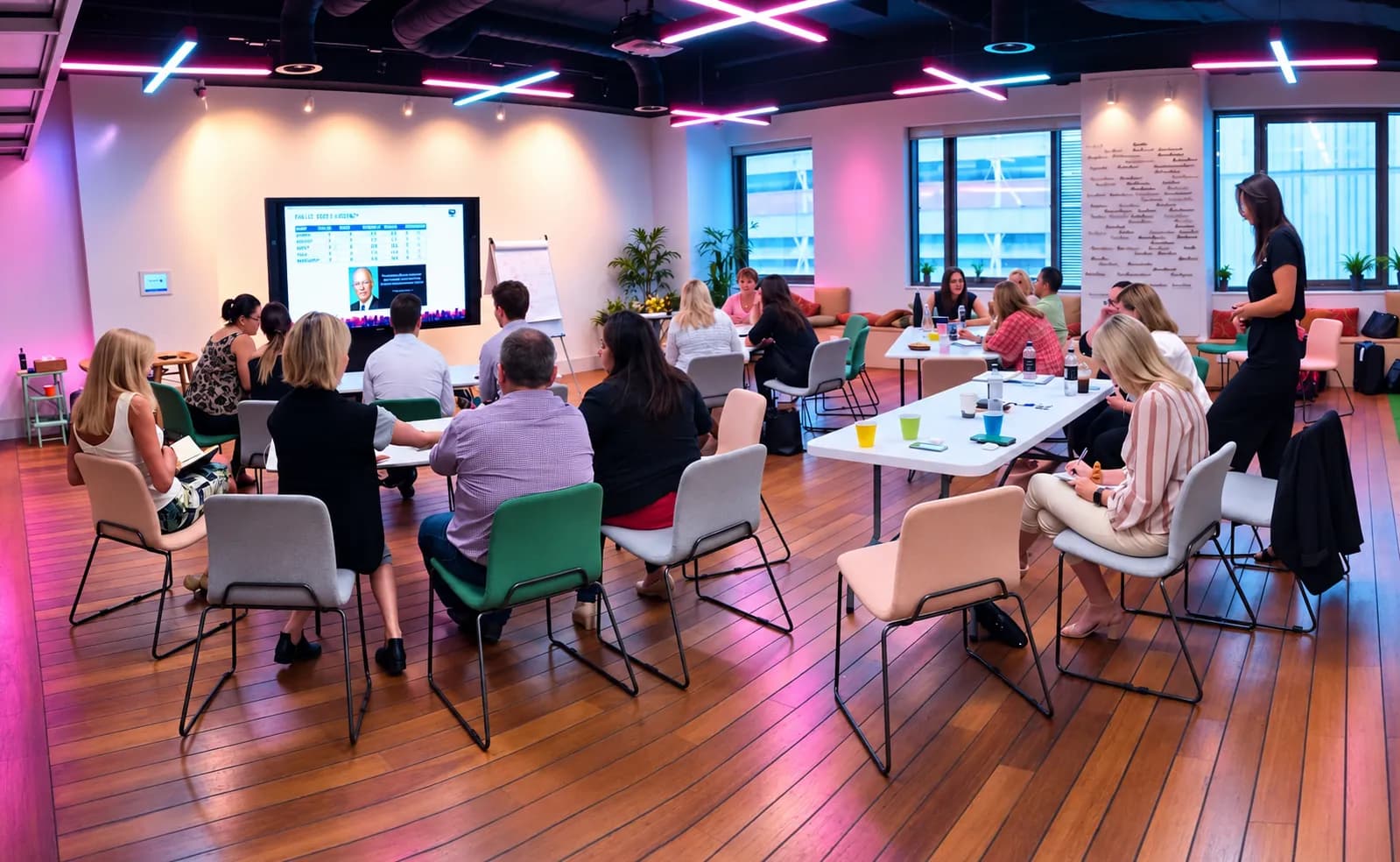
Leadership development is often treated as something that happens to individuals: send a promising manager on a course, hope they come back changed. Sometimes they do. More often they return to a team, a boss and a system that have not changed at all, and the new habits fade. The leadership that matters most in organisations is not individual brilliance but the shared practice of a leadership group and the managers around it: how they set direction, make decisions, coach, handle conflict and lead change together.
Collective Campus runs leadership development workshops for leadership teams, managers and emerging leaders across Australia. The focus is practical capability built on real work. Leaders bring the decisions, conversations and changes in front of them, and the workshop helps them handle those better, together. The work connects closely to team culture, psychological safety and high-performance teams.
Since 2015, Collective Campus has worked with teams in large organisations across Australia and Asia on capability building, and the pattern behind lasting change is consistent. Leaders change when they practise on real work, get honest feedback, learn alongside the people they lead with and have a reason to keep going after the program ends. Every leadership program is designed around those conditions. That means no generic slide decks, no personality labels used as an end in themselves and no promises that a single day will transform a leader. Instead, leaders get clear frameworks, structured practice, peer challenge and support that continues back at work, so the habits they build hold up when the pressure returns.
Quick answer
A leadership development workshop for teams builds the practical skills leaders use every day: setting clear direction, making and explaining decisions, coaching, giving feedback, leading through change and creating a team where people speak up. The most effective programs work with intact leadership teams or cohorts of managers, use their live challenges as the material, include practice and feedback, and build in follow-up so new habits stick. Collective Campus tailors every leadership program after a scoping call; there is no fixed format, length or group size, and prices are discussed only after that call.
What leadership development for teams means
Leadership development usually falls into one of three types:
- Individual development: coaching, assessments and courses for a single leader. Useful, but limited in its effect on the wider team.
- Cohort development: a group of managers at a similar level learning together, such as new people leaders or senior managers. Good for building a shared language and peer support across an organisation.
- Leadership team development: an intact leadership group working on how it leads together, including its decisions, priorities, relationships and the signals it sends to the organisation.
Collective Campus focuses on the second and third types, because that is where leadership capability compounds. A leadership team that makes clearer decisions and models better behaviour changes the experience of everyone who reports to it. A cohort of managers who share a coaching approach creates consistency across the organisation.
Why organisations invest in leadership development now
- Managers are carrying more. Flatter structures, hybrid work and constant change mean frontline and middle managers hold more responsibility with less support.
- First-time managers are promoted for technical skill. Many people step into leadership because they were excellent at their previous job, then receive little help learning a very different one.
- Change is constant. Restructures, new technology, AI adoption and shifting strategy all depend on leaders who can explain, involve and support people through change.
- Wellbeing and psychosocial risk. Leadership behaviour strongly shapes psychosocial hazards such as unclear roles, poor support and high demands. Australian employers have explicit duties to manage psychosocial hazards, and capable leaders are a large part of that.
- Engagement and retention. People commonly leave because of their manager. Better leadership is one of the most direct ways to keep good people.
- Leadership teams that do not function as teams. Many senior groups are a collection of functional heads rather than a team with shared priorities. That shows up in slow decisions, mixed messages and silos.
What the workshop covers
Each program is designed around the leaders' context. These are the building blocks Collective Campus draws on.
1. Leadership identity and the shift from doing to leading
For newer leaders, the hardest transition is letting go of the work that made them successful. Leaders explore what their role really requires now, where their time goes and which tasks they need to stop doing so they can lead. For experienced leaders, the focus is on how their leadership style lands on others and where it helps or hinders.
2. Setting direction and creating clarity
Teams perform better when they understand what matters, why and how their work fits. Leaders practise translating strategy into priorities their teams can act on, writing clear goals and explaining the reasoning behind them. Clarity is also one of the strongest protections against psychosocial risk.
3. Decision-making
Slow, unclear or reversed decisions are a common source of frustration. Leaders learn practical approaches to decision-making: being clear about who decides and how, separating reversible from hard-to-reverse decisions, involving the right people without consulting endlessly and communicating decisions well.
4. Coaching conversations
The shift from telling to coaching is one of the most valuable a leader can make. Leaders practise asking better questions, listening properly and helping people solve their own problems. Practice uses real situations from participants' teams.
5. Feedback that lands
Most leaders avoid feedback or deliver it poorly. Leaders practise a simple, respectful structure for giving feedback, both positive and critical, and learn how to ask for and receive feedback themselves.
6. Difficult conversations and conflict
Performance issues, behaviour concerns and disagreements between team members all require conversations many leaders put off. The workshop builds skills and confidence for those conversations, with practice in a safe setting.
7. Building psychological safety
Leaders have the greatest influence on whether people feel safe to speak up, raise problems and try new things. They learn the specific behaviours that build or erode psychological safety and agree what they will do differently.
8. Leading change
Change fails more often from how it is led than from what it is. Leaders practise explaining change, involving people in shaping it, handling resistance with curiosity and supporting people through uncertainty.
9. Leading hybrid and distributed teams
Leading people who are not in the same place requires deliberate attention to fairness, communication, inclusion and connection. Leaders design practical approaches for their own teams.
10. Leading in an AI world
AI is changing what work is done, how it is done and what skills matter. Leaders need to understand enough to make good decisions, set guardrails, encourage responsible experimentation and support people whose roles are changing. For leadership teams that want a deeper focus, Collective Campus runs a dedicated leadership team AI immersion.
11. Leadership team effectiveness
For intact leadership teams, the program looks at how the group works together: its shared priorities, how it makes decisions, how it handles disagreement, how it holds itself accountable and what signals it sends to the organisation.
12. Personal sustainability
Leadership is demanding. Leaders look at their own energy, focus and boundaries, and how their habits affect their team. Leaders who model sustainable work give their teams permission to do the same.
Why leadership training often fails, and how this is designed differently
Research and experience point to the same reasons leadership programs disappoint. Studies of learning transfer have long described the gap between what is taught and what changes back at work. The common causes are:
- Generic content. Leaders learn models disconnected from their situation. This program uses their live challenges.
- Knowing without doing. Leaders hear about coaching but never practise it. Here, most of the time is practice.
- No change in context. Leaders return to the same system. Involving intact teams and senior sponsors changes the context as well as the person.
- No follow-up. Learning fades without application and reflection. Follow-up sessions, peer groups and coaching are built in.
- No measures. Nobody checks whether behaviour changed. Practical measures are agreed upfront.
Leadership development for different levels
Emerging and new leaders. The focus is the shift from doing to leading, the basics of coaching and feedback, running effective one-on-ones and team meetings, and handling early difficult conversations. New leaders benefit enormously from peer support, so cohort formats work well.
Where workload and meetings are getting in the way, time management and productivity training can help. See how Collective Campus worked with Stuart, ON Running and Charter Hall.
Middle managers. Middle managers translate strategy into action and carry a great deal of change. The focus is clarity, prioritisation, leading change, managing upward and across, and developing their own team leaders.
Senior leaders and leadership teams. The focus shifts to leadership team effectiveness, enterprise thinking, decision-making, culture signals and leading through ambiguity. Sessions are often built around the leadership team's real strategic choices.
Technical and specialist leaders. Leaders in engineering, legal, finance, clinical and other specialist areas often lead highly expert people. The focus is on leading experts, balancing technical work with leadership and creating space for others to grow.
A hypothetical example of a leadership program design
The following is illustrative only, to show how a program can be shaped around real work.
A leadership team preparing for a major restructure wants its managers to lead the change well. The scoping call identifies three needs: managers are unclear on the reasons for the change, they are anxious about difficult conversations and they tend to avoid involving their teams.
The program might begin with a session for the leadership team on the change story and on the behaviour they will model. It would continue with sessions for managers on explaining change, holding difficult conversations and involving teams in shaping the details, using the actual restructure as the practice material. Between sessions, managers would hold real conversations and bring back what happened. Follow-up clinics would give managers help with the hardest cases. The leadership team would review progress against simple measures, such as how informed and supported staff feel.
Leadership in Australian workplaces
Australian workplace culture has some features worth designing for. Many teams value directness, informality and a low tolerance for hierarchy for its own sake, while organisations themselves can be quite hierarchical. Leaders often need to balance plain speaking with care, and authority with genuine involvement. Australian employment law, Fair Work requirements, work health and safety duties and the positive duty to prevent sexual harassment all place obligations on leaders. Leadership programs that ignore these realities feel imported. Collective Campus designs programs for Australian contexts, with examples and practice drawn from the participants' own work.
Simple structures for the conversations leaders avoid
Leaders tend to put off the same few conversations. The workshop gives them simple structures and lots of practice. Here are three of the structures used.
Feedback: situation, behaviour, impact, next step. Describe the specific situation, the observable behaviour (not a judgement of character), the impact it had and what you would like to see next time. Then stop and listen. For example: "In yesterday's client meeting, when you answered the pricing question before the client finished, they seemed to stop engaging. Next time, could you let them finish and check what they meant?" The structure keeps feedback specific, fair and focused on the future.
Coaching: goal, reality, options, way forward. Ask what the person wants to achieve, what is happening now, what options they see and what they will do next. The leader's job is mostly to ask and listen, resisting the urge to give the answer. Leaders are often surprised by how much people can solve on their own when given space.
Difficult conversations: prepare, open, explore, agree. Prepare by getting clear on the facts, your intent and the outcome you want. Open by naming the issue directly and kindly. Explore by asking for the other person's view and listening properly. Agree on what happens next and when you will check in. Most difficult conversations go better than leaders fear, and nearly all go better than avoiding them.
Inside a leadership team session
Intact leadership teams face challenges that individual development cannot reach. A leadership team session usually explores five questions.
What are we, as a team, actually responsible for? Many leadership teams operate as a meeting of functional heads, each representing their own area. A team that agrees its shared responsibilities, beyond each member's function, behaves very differently.
What are our few shared priorities? Leadership teams often have too many priorities, which means they have none. Agreeing a short list, and what the team will stop doing, gives the whole organisation clarity.
How do we make decisions? Clear decision rights, a rhythm for decisions and a norm of commitment after debate remove a great deal of friction.
How do we handle disagreement? Leadership teams that avoid conflict make worse decisions and pass the conflict down to their teams. Teams practise healthy debate and agree how they will raise and resolve disagreements.
What signals are we sending? The organisation watches the leadership team closely. The team considers how its behaviour, communication and unity, or lack of it, are read by others, and agrees what it wants to model.
Questions leaders can ask themselves
These reflective questions are used throughout programs and are useful for any leader.
- Do the people in your team know what matters most right now, and why?
- When did you last have a coaching conversation rather than giving an answer?
- Which conversation have you been putting off, and what is it costing?
- How do people react when they bring you bad news?
- Who in your team rarely speaks, and why might that be?
- What are you doing that someone else in your team should be doing?
- How would your team describe your leadership to a friend?
- What are you modelling about workload, focus and wellbeing?
- How are you helping your team adapt to new technology, including AI?
- What would you want your team to say about this year when it is over?
Learning between sessions
The most important part of a leadership program often happens between sessions. Leaders are asked to apply one thing at a time on real work, then reflect on what happened. Useful practices include a short weekly reflection, a peer partner from the program to compare notes with, a specific conversation to hold before the next session and a small experiment with a new behaviour. Leaders bring their experience back to the group, which turns individual practice into shared learning. Over time, this rhythm builds habits that last well beyond the program itself.
Formats (shaped after a scoping call)
Every program is tailored after a scoping call, so there is no fixed length, headcount or package. What changes from one organisation to the next is the mix of the elements below, chosen to fit the outcome the team needs and the real constraints on its time.
- Focused workshop. A single facilitated session built around one live problem the team brings into the room. Best when the goal is a shared language, a quick diagnosis and a small number of agreed next steps.
- Workshop series. A sequence of shorter sessions spaced out so people apply each idea at work between sessions and bring back what happened. Best when the goal is behaviour change rather than awareness.
- Applied program. Training combined with a real piece of work: a service, process or team challenge the group moves forward while learning. Best when leaders want a visible result, not just a completion record.
- Leadership session plus team rollout. Leaders go first so they can model the behaviour and remove blockers, and then teams follow with sessions that reflect what leaders agreed.
- Coaching and follow-up. Check-ins, clinics or office hours after the formal sessions so teams get help when they hit the hard part of applying the method.
- In person, remote or hybrid. Delivered on site in Sydney, Melbourne, Brisbane and other Australian cities, or live online for distributed teams. Remote sessions are designed for remote work rather than a slide deck streamed over video.
The scoping call covers who is in the room, what is already in place, what success looks like in practical terms and what would get in the way. The design follows from those answers.
What leaders leave with
- Clearer priorities and direction they can explain to their teams.
- Practical tools for decision-making and for communicating decisions.
- Coaching and feedback skills practised on real situations.
- Confidence for difficult conversations and conflict.
- Specific behaviours to build psychological safety in their teams.
- A plan for leading the change in front of them.
- For leadership teams, agreed ways of working together, including how they decide and hold each other accountable.
- Peer support from colleagues who shared the program.
Just as importantly, leaders leave with a clear sense of what they will do differently on Monday morning, who they will do it with and how they will know it is working. That specificity is what separates a leadership program people remember fondly from one that changes how a team is led. Sponsors receive a short summary of themes and agreed actions, never individual confidences, so the organisation can support leaders well.
How to tell whether it worked
Agree a few practical measures before the program starts, so success is judged on evidence rather than on how the session felt. Useful measures for this topic include:
- Team feedback on the leader. Short, targeted upward feedback on clarity, support, coaching and fairness, compared over time.
- One-on-ones held. Whether leaders hold regular, useful one-on-ones with each team member.
- Decision speed and clarity. Whether decisions are made faster, communicated better and reversed less often.
- Difficult conversations. Whether performance and behaviour issues are raised earlier.
- Engagement and retention. Engagement items and unplanned turnover in the leaders' teams, read with care.
- Change readiness. How informed and supported staff feel during change.
- Leadership team health. For leadership teams, a short self-assessment of trust, conflict, commitment, accountability and focus on results.
- Application stories. Specific examples of leaders using what they learned, gathered in follow-up sessions.
Why capability building beats one-off training
Most training fails for a simple reason: people learn something in a room, return to a full inbox and an unchanged system, and within a few weeks behaviour drifts back to where it started. The research on learning transfer has said this for decades. What predicts whether learning sticks is less about the quality of the session and more about what happens around it: whether leaders expect and reinforce the new behaviour, whether people get to apply it immediately on real work, and whether the system they work in makes the new way easier rather than harder.
Collective Campus designs for transfer from the start. That means working on live problems rather than case studies from other companies, involving leaders so they can reinforce the change, building in practice and follow-up between sessions, and agreeing practical measures upfront. It also means being honest when training is not the answer. Sometimes the real blocker is a policy, an incentive or a system, and the most useful thing a scoping call can do is name it.
The difference shows up in what teams say afterwards. A one-off session produces "that was interesting." A capability building program produces "this is how we work now," along with the evidence of a changed process, a fixed journey or a decision made differently.
Comparing provider types
Leadership development is a crowded market. The general comparison below describes provider types, not individual firms.
- Capability building provider such as Collective Campus. Typically strong at: Practical programs for intact teams and cohorts, built on live work. Watch out for: Needs leaders to commit time and practise between sessions. Best fit when: You want leadership behaviour to change in the teams that matter now.
- Business school executive education. Typically strong at: Strategic thinking, prestige and broad networks. Watch out for: Removed from the leader's day-to-day work and team. Best fit when: A senior leader needs broad strategic development.
- Large leadership consultancy. Typically strong at: Enterprise frameworks, assessments and large-scale programs. Watch out for: Can be standardised and slow to tailor. Best fit when: You need one framework rolled out across thousands of leaders.
- Registered training organisation. Typically strong at: Accredited leadership and management qualifications. Watch out for: Generic content, assessment focused. Best fit when: Formal qualifications are required.
- Individual executive coach. Typically strong at: Deep, personal development for one leader. Watch out for: Limited effect on the wider team and system. Best fit when: One leader needs focused support.
Decision checklist: choosing a provider
Use these questions when comparing providers. A strong provider will answer most of them clearly before any proposal is written.
- Will the program use our leaders' real challenges?
- How much of the time is practice rather than presentation?
- Can it work with intact leadership teams as well as cohorts?
- How will senior leaders and sponsors be involved?
- What follow-up is built in after the sessions?
- How will we know whether behaviour changed?
- Does the content reflect Australian workplace realities and obligations?
- Does it cover leading change, hybrid teams and AI, not just classic models?
- Can it be delivered in person and remotely?
- Can the provider show relevant, real experience?
- Will leaders build peer support that lasts beyond the program?
- Is it tailored after a scoping call rather than taken off the shelf?
How Collective Campus scopes and runs a program
Collective Campus has been running capability building programs for teams in large organisations since 2015. The approach is the same whatever the topic.
- Scoping call. A conversation with the sponsor, and often with a few people from the team, about the outcome, the context and the constraints. Nothing is proposed before this call, because a generic proposal would be guessing.
- Discovery. Where it helps, short interviews or a brief survey with participants so the content reflects their real work and the language they use.
- Design. Content, exercises and examples are built around the team's own situations. Generic case studies are kept to a minimum; the team's live work is the main material.
- Delivery. Highly practical, facilitated sessions where most of the time is spent doing rather than listening. Participants leave with things they made, not just notes.
- Application. Agreed actions, owners and a simple way to check progress, so the work continues after the facilitators leave.
- Review. A debrief with the sponsor on what changed, what got stuck and what the team needs next.
Pricing, format and timing are all discussed after the scoping call, once both sides understand what the work actually involves.
Preparing for a program
A little preparation makes a large difference to the result.
- Name a sponsor. Someone senior enough to remove blockers and to ask about progress afterwards.
- Pick real work. Bring a live problem, journey, project or decision the team actually needs to move. Abstract exercises produce abstract results.
- Tell participants why. People engage more when they know why they are there and what will be different afterwards.
- Protect the time. Sessions interrupted by email and calls produce half the value. Agree that the time is protected.
- Plan the week after. Book the first follow-up action before the program starts, so momentum is not lost.
- Gather what already exists. Data, feedback, previous reviews and earlier attempts all help tailor the content.
Key terms
- Leadership development: Building the skills, behaviours and judgement leaders need to lead people and organisations well.
- Leadership team: An intact group of senior leaders who share responsibility for an organisation or function.
- Coaching style: A leadership approach that helps people solve their own problems through questions and listening.
- One-on-one: A regular conversation between a leader and a team member focused on support, development and priorities.
- Psychological safety: A shared belief that it is safe to take interpersonal risks such as speaking up.
- Change leadership: Guiding people through change by explaining, involving and supporting them.
- Reversible decision: A decision that can be changed later at low cost, which can therefore be made quickly.
- Upward feedback: Feedback from team members to their leader.
- Psychosocial hazard: A work-related factor that may cause psychological harm.
- Learning transfer: The extent to which learning is applied back at work.
- Peer learning group: A small group of leaders who meet to share challenges and support each other.
- Hybrid leadership: Leading teams that work partly in the office and partly elsewhere.
Supporting first-time managers
The move into a first leadership role is one of the most important and least supported transitions in working life. Someone who was an excellent analyst, engineer, nurse, lawyer or salesperson is suddenly responsible for other people's work, wellbeing and growth, usually with little preparation. The common struggles are predictable: continuing to do the old job instead of leading, avoiding difficult conversations with former peers, trying to have every answer, and overworking to compensate for uncertainty.
Programs for first-time managers focus on the essentials. New leaders learn how to run useful one-on-ones, delegate properly, give feedback early, set clear expectations, handle the shift in relationships with former peers and ask for help. They also learn where to find support in their own organisation, from HR policies to employee assistance. Cohort formats are particularly valuable at this stage, because new managers discover that others face exactly the same challenges, and the peer relationships formed often outlast the program.
Leading in an AI world
AI is changing leadership in three ways, and leaders need practical help with each.
Decisions about AI. Leaders are making choices about which tools to adopt, which processes to redesign and how to manage risk. They need enough understanding to ask good questions, weigh benefits against risks and avoid both overexcitement and paralysis.
Leading people through AI change. Team members feel a mix of curiosity, excitement and anxiety about AI. Some worry about their relevance or their jobs. Leaders need to talk about AI honestly, involve people in deciding how it is used, protect quality and support people whose roles are changing. Creating a culture where it is safe to experiment, and safe to say when something did not work, matters a great deal.
Leaders' own use of AI. Leaders who use AI tools themselves, thoughtfully and visibly, understand the opportunities and limits better and give their teams permission to learn. Leaders also need to model good judgement, such as checking AI output, protecting confidential information and not outsourcing their thinking.
Collective Campus is a capability building company, and AI is one of the areas where it builds capability, alongside leadership, culture, design thinking and customer experience. Leadership programs often weave AI into the change leadership topics, while leadership teams wanting a deeper focus can take the dedicated AI immersion.
Signs leadership capability is holding a team back
Leadership problems rarely announce themselves. They show up as symptoms that are easy to blame on other causes. These are the signs that leadership development is likely to help:
- Decisions go up and come back slowly. People escalate choices they could make themselves because they are unclear on their authority or afraid of getting it wrong.
- The same problems keep returning. Issues are patched rather than solved, often because nobody has the conversation that would address the root cause.
- Good people leave, and exit conversations mention their manager. This is one of the clearest signals available.
- Meetings are full of updates and short of decisions. Leaders use meetings to report rather than to think, decide and solve problems together.
- Change initiatives stall in the middle of the organisation. Senior leaders announce change, frontline staff wait to see what happens, and middle managers are left without the skills or support to lead it.
- Leaders are exhausted. When leaders work long hours doing work their teams could do, the problem is usually delegation, prioritisation and confidence, all of which can be developed.
- Feedback is rare or only happens at review time. Performance surprises, in either direction, are a sign that everyday feedback is missing.
- The leadership team says different things. When staff hear inconsistent messages from different senior leaders, the leadership team has work to do on alignment.
None of these is a reason for blame. They are usually the predictable result of promoting people without preparing them, and of busy leadership teams never stepping back to look at how they work together. Practical development addresses them directly.
Talk to Collective Campus
If your leaders are carrying more than ever and need practical help, a short scoping call is the place to start. It covers who the leaders are, what they are facing and what better leadership would look like in practice. Book a scoping call.
Frequently asked questions
- What is a leadership development workshop?
- It is a facilitated, practical session or series where leaders build skills such as setting direction, decision-making, coaching, feedback, difficult conversations and leading change, using their own real challenges.
- How long is a leadership development program?
- There is no fixed length. Collective Campus tailors each program after a scoping call, based on the leaders, their challenges and the outcome needed.
- How much does leadership training cost?
- Collective Campus does not publish prices. Pricing is discussed after a scoping call, once the scope is clear.
- Is this for new managers or senior leaders?
- Both. Programs are designed for emerging leaders, middle managers, senior leaders and intact leadership teams, with different emphasis for each.
- Can you run a leadership team offsite?
- Yes. Collective Campus designs and facilitates leadership team sessions built around the team's real priorities, decisions and ways of working together.
- Does the program include coaching?
- Follow-up coaching, clinics and peer groups can be built in, depending on what the scoping call identifies.
- How is this different from a business school course?
- Business school programs are usually broad and removed from day-to-day work. These programs are built around the leaders' live challenges and often work with intact teams.
- Does it cover leading in an AI world?
- Yes. Leading through AI adoption is one of the topics available, and Collective Campus also runs a dedicated leadership team AI immersion.
- Can it be delivered remotely?
- Yes. Programs can be in person, remote or hybrid, and leading distributed teams is a topic in its own right.
- Where does Collective Campus run leadership workshops?
- In Sydney, Melbourne, Brisbane and other Australian cities, and live online.
Tell us about your team
A short scoping call is the next step. You can also send a note about what the team is working on.