
AI adaptability
AI adaptability training for employees
- Tailored after a scoping call
- In person or remote
- For every employee
- Vendor neutral
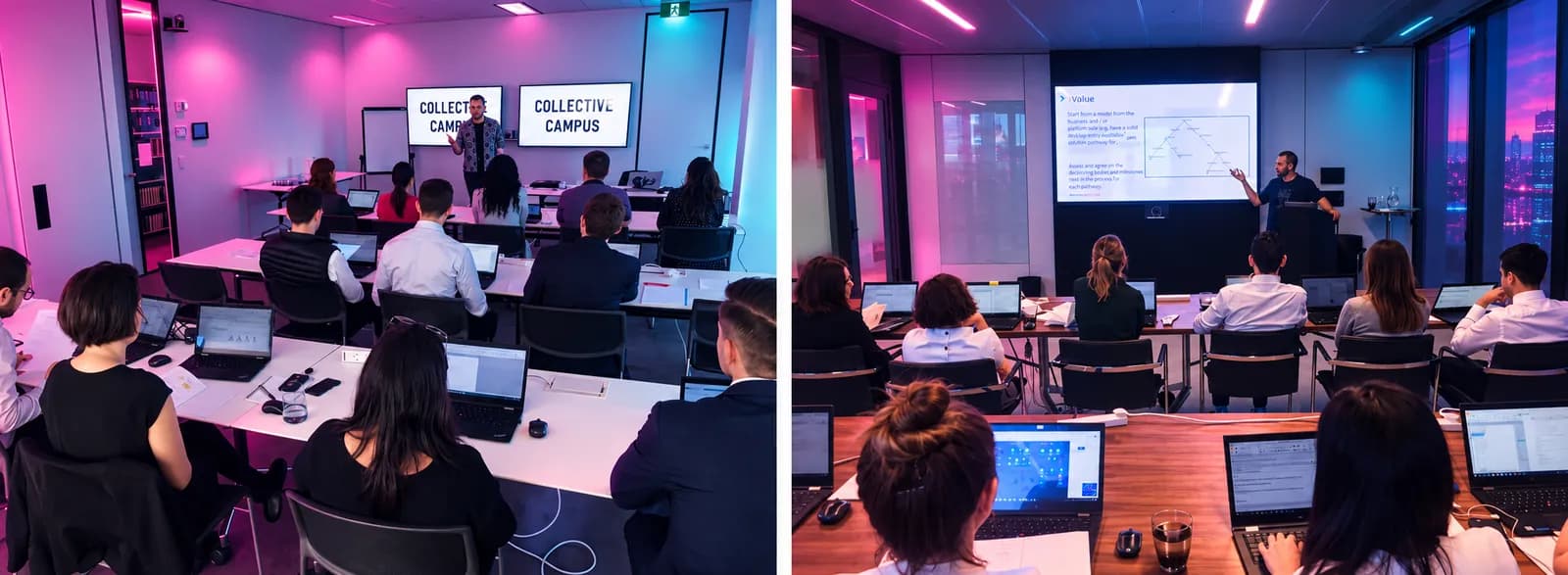
Most AI training teaches people how to use a particular tool. That matters, but tools change every few months. Features appear and disappear, new assistants arrive and yesterday's best practice becomes outdated. What lasts is adaptability: the mindset, judgement and habits that let people keep learning, experiment safely and decide well about when and how to use AI as the technology keeps moving.
Collective Campus runs AI adaptability training for employees and teams across Australia. It sits alongside hands-on AI training and is built for the people side of AI adoption: curiosity rather than fear, confident experimentation rather than paralysis, and good judgement rather than blind trust. Collective Campus is a capability building company that has been working with teams since 2015, and AI is one area of that work alongside leadership, culture, design thinking and customer experience.
The training is practical from the first minute. Participants bring their own tasks, use the AI tools their organisation has approved and leave having changed at least one part of how they work. Along the way they talk openly about what worries them, learn where AI is genuinely useful and where it is not, and build simple habits for checking output and protecting information. Programs are designed for whole teams, so colleagues learn together, agree shared practices and keep supporting each other after the session ends. The result is a workforce that is not just trained on today's tools but ready for whatever comes next.
Quick answer
AI adaptability training helps employees build the mindset and habits to work well with AI as it changes. It covers how AI tools work and where they fail, how to experiment safely, how to redesign one's own work with AI, how to keep critical judgement, how to protect privacy and quality, and how to keep learning without being overwhelmed. The most effective programs are hands-on, use participants' real tasks, address anxiety openly and are supported by leaders and local champions. Collective Campus tailors every program after a scoping call, with no fixed format, length or group size, and does not publish prices. Programs suit both organisations just starting with AI and those whose rollout has stalled.
What AI adaptability means
AI adaptability is the ability of a person or team to keep adjusting how they work as AI capabilities change. It combines several things:
- Mindset: curiosity, a willingness to experiment and a realistic view of AI, neither dismissive nor starry-eyed.
- Understanding: enough grasp of how AI tools work, what they are good at and where they fail to make sensible choices.
- Judgement: the critical thinking to check output, notice errors and decide when AI should not be used.
- Habits: regular, small experiments with AI on real work, and a practice of sharing what works.
- Responsibility: awareness of privacy, confidentiality, bias, quality and policy obligations.
- Resilience: the ability to handle uncertainty about roles and skills without freezing or disengaging.
Tool training answers "how does this feature work?" Adaptability training answers "how does a person keep getting value from AI safely, whatever tools the organisation has next year?"
Why organisations need AI adaptability, not just AI skills
Organisations rolling out AI tools often find that access does not equal adoption. Licences are bought, launch sessions are held and usage remains patchy. The reasons are rarely technical:
- Anxiety. Some employees fear AI will replace them, and avoid it or quietly resist it.
- Uncertainty about what is allowed. Without clear guidance, cautious people do nothing and bold people take risks.
- Lack of relevance. Generic demos do not show people how AI helps with their own tasks.
- Overwhelm. The pace of change makes people feel they can never keep up, so they disengage.
- Over-trust. Some people accept AI output without checking, creating quality and reputational risks.
- No time to experiment. Busy teams never get space to try new ways of working.
- Culture. Where mistakes are punished, people hide their AI use or avoid it entirely.
AI adaptability training addresses these people factors directly. It is often the missing piece between buying AI tools and seeing them change how work gets done.
What the training covers
Each program is designed around the participants' roles, the tools they have access to and the organisation's policies. These are the building blocks Collective Campus draws on.
1. A realistic picture of AI
Participants build an accurate mental model of how generative AI works, what it does well (drafting, summarising, brainstorming, analysing, explaining) and where it fails (confident errors, outdated or invented information, bias, weak reasoning on unfamiliar problems). A realistic view reduces both fear and over-trust.
2. Working through the emotions of AI change
The program makes room to talk honestly about concerns: relevance, job security, deskilling and fairness. Participants explore how roles tend to change with AI, which human skills become more valuable and how they can shape their own role rather than wait for it to be reshaped.
3. The experimenter's mindset
Participants learn to treat AI use as a series of small experiments: try something on a real task, compare the result, keep what works, share it and move on. This lowers the stakes of trying and builds confidence quickly.
4. Redesigning your own work
Rather than asking "what can AI do?", participants ask "which parts of my work take the most time, and which could AI help with?" They map their own tasks, identify good candidates for AI support and test them. This draws on design thinking and is the same approach used in Collective Campus AI design sprints.
5. Prompting as thinking
Good prompting is less about tricks and more about clear thinking: giving context, specifying the goal, setting constraints, asking for options and iterating. Participants practise on their own tasks and learn reusable patterns.
6. Judgement and verification
AI adaptability depends on keeping one's critical faculties sharp. Participants practise checking AI output for accuracy, completeness, bias and tone, and deciding when a task needs human judgement rather than automation. This connects to Collective Campus critical thinking training, which focuses on thinking well in an AI world.
7. Safe and responsible use
Participants learn the organisation's AI policy and the principles behind it: what information can and cannot be shared with AI tools, how to protect personal information under the Australian Privacy Principles, how to handle confidential and client material, how to be transparent about AI use and how to escalate concerns. The Australian Government's Voluntary AI Safety Standard provides helpful principles that many organisations reference.
8. Learning how to keep learning
Participants build a simple, sustainable learning habit: a small amount of regular experimentation, a few trusted sources, a way to share discoveries with colleagues and a sense of what not to worry about. The aim is confidence without overwhelm.
9. Team practices for AI adoption
Adaptability is not only individual. Teams agree how they will share prompts and use cases, review AI-assisted work, keep quality high and support colleagues who are less confident. Many organisations formalise this through AI champions who help their teams adopt AI well.
10. Human skills that matter more
As AI takes on more routine drafting and analysis, the value of human skills rises: framing the right problem, understanding customers, building relationships, exercising judgement, collaborating and leading change. Participants identify which of these skills they want to strengthen.
A hypothetical example of AI task redesign
The following is illustrative only, to show the kind of exercise used in the training.
A policy officer spends a large part of each week summarising stakeholder submissions and drafting briefing notes. In the training, they map these tasks and pick one to test: producing a first summary of a batch of de-identified submissions. They write a prompt that explains the context, the required structure and the need to flag disagreements. They compare the AI summary with their own reading of a sample, finding that it captured most themes but missed one minority view and overstated another. They adjust the prompt, add a verification step and agree with their manager that AI summaries are a first draft only, always checked against the source. The time saved goes into deeper analysis and better engagement with stakeholders.
The lesson is not that AI does the job. It is that the officer redesigned part of their work, kept their judgement in charge and freed time for more valuable tasks.
Case study: from AI access to real outcomes
M3 Property had already given its people access to Microsoft Copilot and wanted to turn that access into real changes in how work gets done, while protecting the quality and professional standards its clients rely on. Collective Campus ran a hands-on AI design sprint inside the firm's annual staff conference. Teams learned design thinking, lean startup, customer interviewing and jobs to be done, mapped one real process each, generated ideas and built working prototypes in Copilot before pitching to leadership. The day produced 20 ideas, 8 pitches and 2 winners, with the strongest ideas going to M3's internal team for prioritisation and development.
The approach shows what AI adaptability looks like in practice: people working on their own problems, experimenting with AI, applying judgement and sharing what they found.
AI adaptability in Australian organisations
Policy and governance. Many Australian organisations now have AI policies, and government agencies follow policy on the responsible use of AI in government. Adaptability training helps employees understand and apply these policies in everyday decisions, rather than treating them as a document they once acknowledged.
Privacy. Personal information is protected under the Privacy Act and the Australian Privacy Principles, and privacy reforms continue. Employees need clear, practical guidance on what can be entered into AI tools.
Regulated professions. Lawyers, accountants, financial advisers, clinicians and engineers have professional obligations that apply to AI-assisted work. Training is tailored to reflect those obligations.
Workforce concerns. Employee and union concerns about AI and jobs are part of the Australian conversation. Programs that address those concerns openly, and involve people in shaping how AI is used, tend to see better adoption and less resistance.
Regional and distributed workforces. Many organisations have teams spread across states and regions. Live online delivery makes adaptability training accessible to everyone, not just head office.
Common AI adoption mistakes the training helps avoid
- Tool launch without behaviour change. Licences are bought, but work does not change.
- Fear left unspoken. Anxiety turns into quiet resistance.
- Rules without reasons. Policies are written but not understood, so people either ignore them or freeze.
- Generic demos. People see impressive examples unrelated to their work and conclude AI is not for them.
- Blind trust. Output is used without checking, creating errors and risk.
- One-off sessions. Initial enthusiasm fades without ongoing practice and support.
- Leaving leaders out. Teams take their cues from leaders, so leaders need to be visible, thoughtful users of AI.
AI adaptability by role
The principles are the same for everyone, but what adaptability looks like varies by role. Programs are tailored so each group works on examples that feel like their own job.
Frontline and customer-facing staff. The focus is on using AI to prepare, summarise and draft while keeping the human relationship at the centre. Staff practise using AI to find information faster and to draft clear responses, while learning where empathy, discretion and accountability must stay with people.
Administrative and operations teams. These teams often have the most repetitive tasks and the biggest early gains. The focus is on mapping workflows, identifying steps AI can support, building checklists for verification and sharing reusable prompts across the team.
Professional and specialist staff. Lawyers, accountants, engineers, analysts, clinicians and policy advisers need to use AI within professional standards. The focus is on judgement, verification, confidentiality and knowing where AI should never be the final word.
Managers. Managers need to use AI themselves, support their teams, set expectations about quality and answer difficult questions about roles. The focus is on leading adoption, creating safe space to experiment and redesigning team workflows.
Leaders and executives. Leaders need enough understanding to make sound decisions about AI investment, risk and workforce impact, and to model thoughtful use. Leadership groups wanting a deeper program can take a dedicated leadership AI immersion.
Technical teams. Developers and data teams often already use AI tools. The focus shifts to responsible use, security, code and data quality, and helping the rest of the organisation adopt AI well.
What leaders can do to build AI adaptability
Training works best when leaders create the conditions for people to use what they learn.
- Talk about AI honestly. Explain what the organisation is trying to achieve with AI and what it means for roles, including what is not yet known.
- Use AI visibly and thoughtfully. Share how AI helps with leadership work, and how output is checked.
- Give permission and time to experiment. Set aside time for teams to try AI on real tasks, and treat failed experiments as learning.
- Make the rules clear. Ensure everyone knows what tools are approved and what information can be shared.
- Recognise sharing. Celebrate people who share useful prompts and use cases, not just those who save the most time.
- Protect quality. Make it clear that AI-assisted work is held to the same standard as any other work.
- Involve people in redesign. Let the people who do the work shape how AI changes it.
Questions employees often ask
"Will AI take my job?" The honest answer is that AI will change many jobs, and some tasks will be automated. People who learn to use AI well, keep their judgement sharp and build the human skills AI cannot replace are best placed. The training helps people shape how their role changes.
"Is it allowed?" That depends on the organisation's policy. The training explains the policy in practical terms, including which tools are approved and what information must never be entered.
"What if it gets something wrong?" It will, sometimes. That is why verification is a core habit. The person using AI remains responsible for the work.
"What if someone is not technical?" Yes. Most AI tools are used through plain language. The skills that matter most are clear thinking, good questions and judgement.
"How can anyone keep up?" By building a small, regular habit of experimenting on real work and learning from colleagues, rather than trying to follow every new release.
Formats (shaped after a scoping call)
Every program is tailored after a scoping call, so there is no fixed length, headcount or package. What changes from one organisation to the next is the mix of the elements below, chosen to fit the outcome the team needs and the real constraints on its time.
- Focused workshop. A single facilitated session built around one live problem the team brings into the room. Best when the goal is a shared language, a quick diagnosis and a small number of agreed next steps.
- Workshop series. A sequence of shorter sessions spaced out so people apply each idea at work between sessions and bring back what happened. Best when the goal is behaviour change rather than awareness.
- Applied program. Training combined with a real piece of work: a service, process or team challenge the group moves forward while learning. Best when leaders want a visible result, not just a completion record.
- Leadership session plus team rollout. Leaders go first so they can model the behaviour and remove blockers, and then teams follow with sessions that reflect what leaders agreed.
- Coaching and follow-up. Check-ins, clinics or office hours after the formal sessions so teams get help when they hit the hard part of applying the method.
- In person, remote or hybrid. Delivered on site in Sydney, Melbourne, Brisbane and other Australian cities, or live online for distributed teams. Remote sessions are designed for remote work rather than a slide deck streamed over video.
The scoping call covers who is in the room, what is already in place, what success looks like in practical terms and what would get in the way. The design follows from those answers.
What employees leave with
- A realistic understanding of AI, including its strengths and failure modes.
- Lower anxiety and more confidence, from having discussed concerns openly and tried AI on real work.
- A map of their own tasks with tested opportunities for AI support.
- Reusable prompting patterns for their common tasks.
- A verification habit that keeps their judgement in charge.
- Clear understanding of what is allowed, under their organisation's policy and Australian privacy obligations.
- A sustainable learning habit that keeps them current without overwhelm.
- Team practices for sharing what works and maintaining quality.
Sponsors also receive a short summary of the themes raised, the use cases tested and the barriers participants identified, such as unclear policy or missing tool access, so the organisation can remove them quickly. Individual responses are never reported by name.
How to tell whether it worked
Agree a few practical measures before the program starts, so success is judged on evidence rather than on how the session felt. Useful measures for this topic include:
- Active use. The share of employees using approved AI tools regularly on real work, not just once.
- Use cases adopted. The number of tested use cases teams are using and sharing.
- Confidence. Self-reported confidence with AI before and after, measured with a few simple questions.
- Anxiety and sentiment. How employees feel about AI and their role, tracked over time.
- Quality. Error rates or rework on AI-assisted work, showing whether verification habits are working.
- Policy understanding. Whether employees can correctly answer practical questions about what is and is not allowed.
- Time redirected. Examples of time saved and where it was reinvested.
- Sharing behaviour. Prompts, tips and use cases shared in team channels or champion networks.
Why capability building beats one-off training
Most training fails for a simple reason: people learn something in a room, return to a full inbox and an unchanged system, and within a few weeks behaviour drifts back to where it started. The research on learning transfer has said this for decades. What predicts whether learning sticks is less about the quality of the session and more about what happens around it: whether leaders expect and reinforce the new behaviour, whether people get to apply it immediately on real work, and whether the system they work in makes the new way easier rather than harder.
Collective Campus designs for transfer from the start. That means working on live problems rather than case studies from other companies, involving leaders so they can reinforce the change, building in practice and follow-up between sessions, and agreeing practical measures upfront. It also means being honest when training is not the answer. Sometimes the real blocker is a policy, an incentive or a system, and the most useful thing a scoping call can do is name it.
The difference shows up in what teams say afterwards. A one-off session produces "that was interesting." A capability building program produces "this is how we work now," along with the evidence of a changed process, a fixed journey or a decision made differently.
Comparing provider types
AI training in Australia comes from many kinds of provider. The general comparison below describes provider types, not individual firms.
- Capability building provider such as Collective Campus. Typically strong at: Hands-on adaptability, task redesign, judgement and team practices. Watch out for: Requires leaders to support experimentation. Best fit when: You want employees to adopt AI confidently and responsibly on real work.
- Technology vendor or reseller. Typically strong at: Product features and licence rollout. Watch out for: Focused on one tool; less on mindset, judgement and change. Best fit when: You need feature training on a specific product.
- Online course platform. Typically strong at: Scalable, self-paced AI literacy content. Watch out for: Low completion and limited relevance to real work. Best fit when: You need baseline awareness at very large scale.
- AI consultancy. Typically strong at: Strategy, use case discovery and implementation. Watch out for: Less focus on employee capability and confidence. Best fit when: You need technical implementation.
- Registered training organisation. Typically strong at: Accredited units in digital and AI skills. Watch out for: Generic content and slower to update. Best fit when: Formal accreditation is required.
Decision checklist: choosing a provider
Use these questions when comparing providers. A strong provider will answer most of them clearly before any proposal is written.
- Does the training go beyond tool features to mindset, judgement and habits?
- Will participants work on their own real tasks?
- How does the program address anxiety and concerns about jobs?
- Does it cover our AI policy and Australian privacy obligations?
- How does it build verification and critical thinking?
- Is it tailored to the tools we actually have?
- How will leaders and champions support adoption afterwards?
- How will adoption and quality be measured?
- Can it be delivered online for distributed staff?
- Is the provider a capability builder rather than only a tool vendor?
- Can the provider show real, relevant case studies?
- Is the program tailored after a scoping call?
How Collective Campus scopes and runs a program
Collective Campus has been running capability building programs for teams in large organisations since 2015. The approach is the same whatever the topic.
- Scoping call. A conversation with the sponsor, and often with a few people from the team, about the outcome, the context and the constraints. Nothing is proposed before this call, because a generic proposal would be guessing.
- Discovery. Where it helps, short interviews or a brief survey with participants so the content reflects their real work and the language they use.
- Design. Content, exercises and examples are built around the team's own situations. Generic case studies are kept to a minimum; the team's live work is the main material.
- Delivery. Highly practical, facilitated sessions where most of the time is spent doing rather than listening. Participants leave with things they made, not just notes.
- Application. Agreed actions, owners and a simple way to check progress, so the work continues after the facilitators leave.
- Review. A debrief with the sponsor on what changed, what got stuck and what the team needs next.
Pricing, format and timing are all discussed after the scoping call, once both sides understand what the work actually involves.
Preparing for a program
A little preparation makes a large difference to the result.
- Name a sponsor. Someone senior enough to remove blockers and to ask about progress afterwards.
- Pick real work. Bring a live problem, journey, project or decision the team actually needs to move. Abstract exercises produce abstract results.
- Tell participants why. People engage more when they know why they are there and what will be different afterwards.
- Protect the time. Sessions interrupted by email and calls produce half the value. Agree that the time is protected.
- Plan the week after. Book the first follow-up action before the program starts, so momentum is not lost.
- Gather what already exists. Data, feedback, previous reviews and earlier attempts all help tailor the content.
Key terms
- AI adaptability: The ability to keep adjusting how one works as AI capabilities change.
- Generative AI: AI that produces text, images, code or other content in response to prompts.
- Large language model: The type of AI model behind most text-based AI assistants.
- Prompt: The instructions and context given to an AI tool.
- Hallucination: Confident but incorrect or invented output from an AI tool.
- Human in the loop: A process where a person reviews or approves AI output before it is used.
- Use case: A specific task or process where AI is applied.
- AI champion: An employee who helps colleagues adopt AI safely and effectively.
- AI policy: An organisation's rules and guidance for using AI tools.
- Deskilling: The loss of skills when tasks are handed to technology and no longer practised.
- Verification: Checking AI output for accuracy, completeness, bias and tone.
- Shadow AI: Use of unapproved AI tools by employees without the organisation's knowledge.
- Task redesign: Rethinking how a task is done, including which parts AI can support.
Building AI adaptability across an organisation
For organisations that want adaptability at scale, rather than in a single team, a staged approach works well. The stages below are a common pattern, adjusted after the scoping call to fit the organisation.
Stage 1: Leaders first. The leadership group builds its own understanding, agrees the organisation's intent for AI and the message it will give staff, and commits to modelling thoughtful use.
Stage 2: Clear guardrails. The organisation confirms which tools are approved, what information can be used and how concerns are escalated. Training is much more effective when these basics are settled.
Stage 3: Champions. A network of AI champions is selected from across teams. They receive deeper training and become the go-to people for colleagues, sharing use cases and helping with problems.
Stage 4: Team-based training. Teams take part in adaptability training using their own tasks. Working in teams, rather than as individuals, means people learn together and agree shared practices.
Stage 5: Practice and sharing. Teams build a rhythm of small experiments and share what works through champions, team channels and show-and-tell sessions.
Stage 6: Redesign. Once confidence grows, teams move from personal productivity to redesigning team workflows and services, using methods such as AI design sprints.
Stage 7: Review and refresh. Adoption, quality and sentiment are reviewed regularly, and training is refreshed as tools and policies change.
Signs a team needs AI adaptability training
- Licences have been bought, but usage is low or concentrated in a few enthusiasts.
- People ask the same basic questions about what is allowed.
- Some staff use unapproved tools because approved ones feel hard to use or are poorly explained.
- AI output is being used without checking, and errors are slipping through.
- Staff express anxiety about AI and jobs, or avoid the topic altogether.
- Teams have not changed any workflow despite having AI tools.
- Leaders talk about AI in strategy documents but rarely use it themselves.
- Enthusiasm from the launch has faded and nothing has replaced it.
If several of these apply, the issue is rarely the technology. It is the mindset, habits, guidance and support around it, which is exactly what adaptability training addresses.
Why adaptability lasts longer than tool skills
Specific features and interfaces will keep changing. The skills built in adaptability training do not depend on any one tool: framing a task clearly, giving good context, checking output, protecting information, experimenting in small steps and sharing what works. A team with these habits can pick up a new assistant or a new feature quickly, because it already knows how to learn. That is the real return on the investment, and it is why Collective Campus treats AI as a capability to build rather than a product to install.
AI adaptability and wellbeing
AI change is not only a skills challenge. For many people it touches identity, security and a sense of competence that took years to build. An experienced professional who has always been the person others ask for help can suddenly feel like a beginner. Ignoring that experience tends to produce quiet disengagement, while acknowledging it opens the door to learning.
Adaptability training therefore pays attention to wellbeing as well as skills. Participants are encouraged to approach AI at their own pace, starting with low-stakes tasks where mistakes do not matter. They learn that feeling uncertain is normal and that nobody has mastered a technology that changes this quickly. Teams agree to support each other, pairing confident users with those who are newer, and to celebrate learning rather than only speed.
Workload matters too. If time saved through AI is immediately filled with more work, people may experience AI as a way to intensify their jobs rather than improve them. Leaders are encouraged to discuss openly how saved time will be used, whether for higher-value work, learning, better service or a more sustainable pace. Under Australian work health and safety duties, high job demands and poor support are recognised psychosocial hazards, so the way AI changes workloads deserves deliberate attention.
Finally, adaptability includes knowing when to switch off. Constant experimentation with new tools can itself become exhausting. A sustainable habit is small, regular and focused on real work, with permission to ignore most of the noise.
Talk to Collective Campus
If your organisation has AI tools but not yet the confidence, habits and judgement to use them well, start with a short scoping call. It covers your tools, policies, people and the outcomes you want. Book a scoping call.
Frequently asked questions
- What is AI adaptability training?
- It is training that builds the mindset, understanding, judgement and habits employees need to keep working well with AI as tools change, rather than training on a single product.
- How is it different from AI tools training?
- Tools training teaches features. Adaptability training teaches people how to experiment, redesign their work, check output, use AI responsibly and keep learning, so the skills last as tools change.
- Who is it for?
- Employees at all levels, including those who are anxious about AI or have not yet started using it, as well as confident users who need better judgement and habits.
- How long is the training?
- There is no fixed length. Collective Campus tailors each program after a scoping call, based on participants, tools and goals.
- How much does AI adaptability training cost?
- Collective Campus does not publish prices. Pricing is discussed after a scoping call.
- Does it cover our AI policy?
- Yes. Programs are tailored to the organisation's AI policy and to Australian privacy obligations, so employees know what is and is not allowed.
- Does it address fears about AI and jobs?
- Yes. The program makes space to discuss concerns honestly and helps people shape how AI changes their roles.
- Which AI tools does it use?
- The tools your organisation has approved, such as Microsoft Copilot, ChatGPT Enterprise or Gemini. The principles apply across tools.
- Can it be delivered online?
- Yes. Programs can be in person, remote or hybrid, which suits distributed and regional teams.
- Is Collective Campus an AI company?
- No. Collective Campus is a capability building company working with teams since 2015. AI is one area of capability alongside leadership, culture, design thinking and customer experience.
Tell us about your team
A short scoping call is the next step. You can also send a note about what the team is working on.