
Customer journey mapping
Customer journey mapping workshops for teams
- Tailored after a scoping call
- In person or remote
- Built around a live journey
- Service, product and ops together
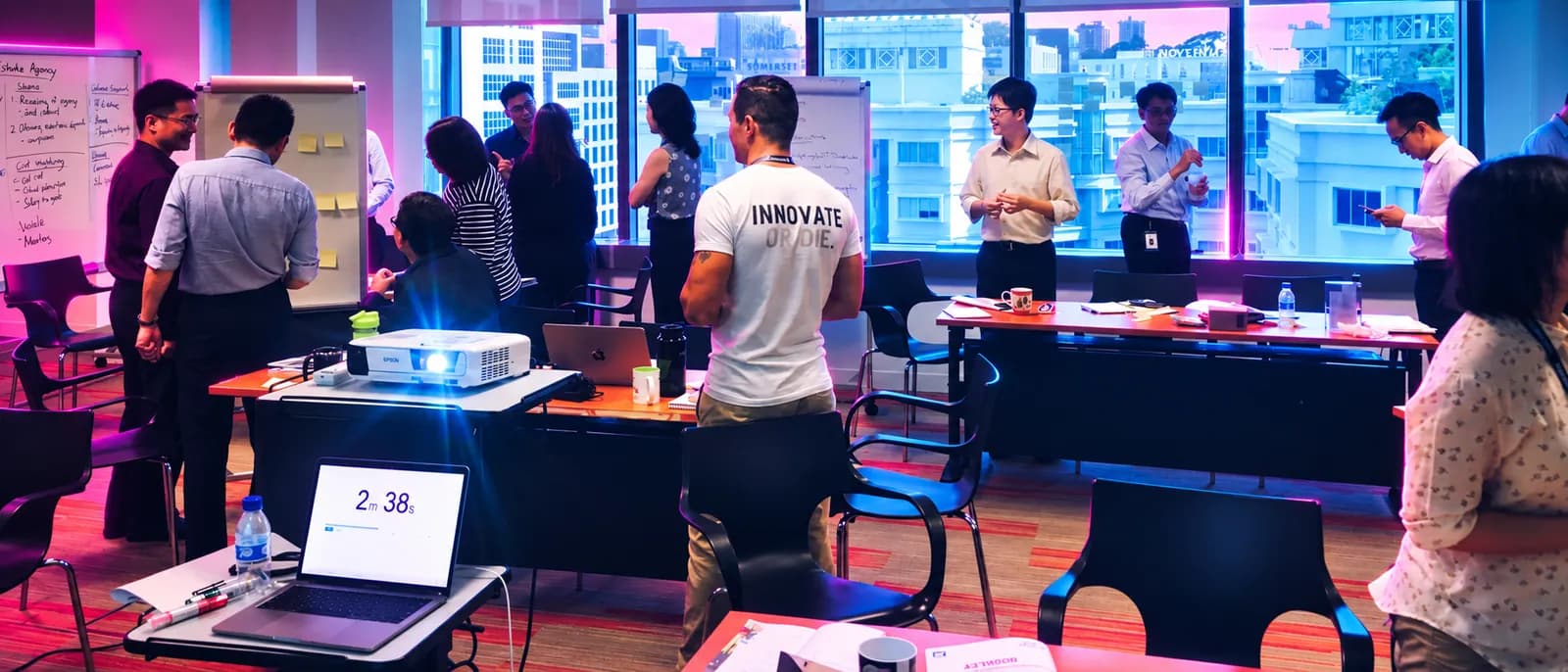
A customer journey mapping workshop helps a team see a service the way customers actually experience it, from the first moment they realise they need something to the point they either get it or give up. Most organisations know their own processes in detail and their customers' experience only in fragments. Each team owns a slice. Nobody owns the whole journey. Friction hides in the handoffs between those slices, which is exactly why it is so rarely fixed.
Collective Campus runs customer journey mapping workshops for teams across Australia as part of its wider capability building work in customer experience and design thinking. The aim is not a pretty poster for the office wall. It is a shared, evidence-based picture of one or two real journeys, a prioritised set of friction points and a plan the team can act on the following week.
Quick answer
A good customer journey mapping workshop takes a team through one or two real, high-volume journeys stage by stage, from the customer's point of view. Participants map touchpoints, actions, thoughts, emotions and effort, mark the moments of truth and the handoffs where the experience breaks, and then prioritise which problems to fix first. The best workshops use real evidence (customer interviews, complaints, call notes, analytics) rather than assumptions, and end with owners and next steps. Collective Campus tailors each workshop after a scoping call; there is no fixed format, length or group size, and prices are discussed only after that call.
What customer journey mapping is, and what it is not
A customer journey map is a visual story of what a specific type of customer does, thinks and feels while trying to achieve a goal with an organisation. It sits on a timeline of stages, and across each stage it shows touchpoints (the channels and moments of contact), the customer's actions, their questions and emotions, the effort involved and the pain points. Underneath, many teams add what the organisation does behind the scenes, which turns the map into a simple service blueprint.
Journey mapping is not the same as process mapping. A process map shows how work moves through the organisation. A journey map shows how the experience lands on the customer. The two often disagree, and that disagreement is the most useful finding in the room. A process that looks efficient internally can feel like being passed from department to department.
It is also not a one-off artefact. A map is a snapshot of current understanding. Its value comes from the conversations it forces, the evidence it exposes as missing and the decisions it makes possible. Teams that treat the map as a deliverable to be signed off tend to file it away. Teams that treat it as a working tool keep improving the journey.
Why teams run a journey mapping workshop
Organisations usually reach for journey mapping when one of these is true:
- Complaints or churn are rising and nobody can say exactly why. Each team can explain its own part, but the overall experience is getting worse.
- A service crosses several teams, channels or systems. Rates notices, claims, onboarding, applications, repairs and returns are classic examples. The more handoffs, the more hidden friction.
- A digital or AI project is about to automate a process. Automating a broken journey only makes it broken faster. Mapping first shows which steps should be removed rather than sped up.
- Leaders want customer centricity to mean something practical. Journey mapping gives a shared method and vocabulary that turns a value statement into specific fixes.
- New CX roles or champions have been appointed. They need a method they can run themselves with their own teams.
- Customers are being asked to repeat themselves. Repeated information, repeated calls and repeated visits are strong signals of broken handoffs.
What the workshop covers
Each workshop is designed around the organisation's own journeys, so the mix below changes from one program to the next. These are the building blocks Collective Campus draws on.
1. Choosing the right journey and scope
The single biggest reason journey mapping workshops disappoint is trying to map everything. A workshop that attempts "the customer experience" ends up with a wall of sticky notes and no decisions. The first step is choosing one or two concrete journeys that are high volume, high pain or strategically important, and agreeing where each journey starts and ends. Teams learn a simple scoring approach to choose journeys and a clear way to write the customer's goal so the map stays focused.
2. Defining who the customer is
A journey looks very different for a first-time customer, a long-standing one, a business customer or someone in a vulnerable situation. Teams build lightweight customer profiles based on evidence rather than stereotypes, with a focus on goals, context, constraints and what success means to that person. Where a service has very different groups, the team maps one primary group and notes where others diverge.
3. Gathering evidence before and during the session
Maps built purely from internal opinion repeat internal blind spots. The workshop shows teams how to bring evidence into the room: short customer interviews, complaint and feedback themes, call centre notes, search and web analytics, frontline staff observations and service data such as wait times and drop-off points. Where evidence is missing, the gap itself is recorded as a finding and a research task, rather than filled with a guess.
4. Mapping the current state, stage by stage
Teams walk the journey through the customer's eyes. For each stage they capture what the customer is trying to do, the touchpoints they use, what they are thinking and feeling, how much effort the step takes and what goes wrong. Facilitators push for specifics: not "the form is confusing" but which question, on which page, causes people to call.
5. Finding the moments of truth
Not all steps matter equally. Moments of truth are the points where customers decide whether to trust, continue, complain or leave. Teams learn to spot them using emotion and effort curves, and to separate moments that merely annoy from moments that break the relationship.
6. Exposing the handoffs and the backstage
Below the line of visibility sit the teams, systems, rules and policies that produce the experience. Teams add these to the map to see where work changes hands, where information is lost and where no one is accountable. This is usually where the root causes of repeat contact and delay become obvious.
7. Prioritising pain points
A good map produces more problems than any team can fix. Teams use a simple impact and effort lens, plus customer evidence, to agree which handful of pain points to tackle first. The aim is a short list that leaders can actually resource.
8. Reframing problems and generating ideas
Prioritised pain points are turned into "how might we" questions, and the group generates ideas across policy, process, people, communication and technology. Teams are encouraged to consider removing steps entirely rather than improving them.
9. Designing the future state and testing quickly
For the top ideas, teams sketch a better version of the journey and identify the riskiest assumption in each idea. They then plan small, fast tests: a reworded letter, a changed form, a new script, a single handoff fixed for a month. This borrows directly from design thinking and lean startup methods.
10. Making it stick
The workshop ends with owners, next steps, measures and a date to review. Teams also agree who keeps the map alive, how often it is revisited and how new evidence gets added. Where the goal is to build internal capability, participants practise facilitating parts of the method so they can run it again without outside help.
Journey mapping in Australian organisations
Journey mapping in Australia has some local features worth designing for.
Government and councils. State agencies and local councils increasingly design services around life events and resident journeys rather than departmental structure. Journey mapping fits this well, because it shows how a resident experiences a service that touches several teams. Collective Campus has run this work with local government, including the customer journey mapping workshop described below.
Regulated sectors. Banks, insurers, superannuation funds, energy retailers and telcos operate under customer outcome obligations and complaint handling standards. Journey mapping helps these teams see where customers struggle, where vulnerable customers need extra support and where processes could produce poor outcomes, before a regulator or ombudsman points it out.
Privacy and customer data. Evidence for maps often includes customer records, complaints and recordings. Teams should handle this in line with the Australian Privacy Principles and their own policies, using de-identified examples wherever possible.
Distributed teams. Many Australian organisations have teams spread across states and regional centres. Journey mapping works well remotely with shared digital whiteboards, provided the session is designed for remote work.
Common journey mapping mistakes, and how the workshop avoids them
- Mapping the organisation, not the customer. Steps get described in internal language. Facilitators keep rewriting steps in the words a customer would use.
- No evidence. The map reflects the loudest opinion. The workshop builds in evidence and records gaps as research tasks.
- Too broad. Every journey at once. Scope is agreed upfront and held firmly.
- Beautiful but useless. Time is spent on design rather than decisions. The output is judged by the actions it produces.
- No owner. The map is filed away. Owners and a review date are agreed before the session ends.
- Skipping the backstage. Without the handoffs and systems, teams fix symptoms. The backstage layer is mapped on purpose.
Case study: local council customer journey mapping
The City of Whittlesea wanted to see two high-volume resident services the way residents actually experience them: council rates and damaged bin requests. Both look simple from the inside but stretch across several touchpoints, teams and systems. Collective Campus ran a customer journey mapping workshop that deliberately focused on those two concrete processes rather than trying to cover everything. The team walked each journey through the resident's eyes, mapped touchpoints, surfaced friction and effort, and pinpointed where handoffs between teams and channels broke the experience. Working two contrasting journeys in parallel showed which pain points were specific to one process and which were systemic.
The council left with a shared, visual picture of both journeys and a prioritised set of friction points to fix, moving from "we think residents find this hard" to "here is exactly where, and why."
Collective Campus has also designed customer experience champions training for the City of Marion, giving newly appointed CX champions from across the organisation a foundation in customer experience and the skills to champion change.
Who the workshop is for
- Customer experience, service design and digital teams who want a shared, repeatable method.
- Operational and frontline teams who see the pain points every day but rarely get the whole picture.
- Product, policy and process owners whose decisions shape the experience.
- Leadership teams who want to understand the experience their customers receive and decide where to invest.
- Cross-functional groups formed around a specific journey, where the real value comes from mixing teams that do not usually sit together.
Tools and templates teams use
Teams leave with practical tools they can reuse: a journey selection scorecard, a customer profile template, an evidence checklist, a journey map canvas with stages, touchpoints, actions, thoughts, emotions, effort and pain points, a backstage and handoff layer, a prioritisation matrix, a "how might we" worksheet and a simple test plan. Templates work on paper, in Miro or Mural, or in Microsoft Whiteboard, depending on what the organisation already uses.
Teams also learn how journey mapping connects to related methods: personas and jobs to be done for understanding customers, service blueprints for deeper operational analysis, and experiment design for testing changes. The Nielsen Norman Group's journey mapping primer is a useful companion read for anyone new to the method.
A worked example of a journey map
To make the method concrete, here is a simplified, hypothetical example of how a team might map a common service: a customer reporting a fault and getting it fixed. It is illustrative only and not drawn from any client.
Stage 1: Noticing the problem. The customer realises something is wrong. They feel mild annoyance and uncertainty about who to contact. Touchpoints: none yet, or a search engine. Pain point: it is not obvious whether to call, use the app or fill in a web form.
Stage 2: Reporting it. The customer finds a web form. It asks for an account number they do not have to hand. Effort rises sharply. Some customers give up and call instead, which doubles contact volume for the organisation. Moment of truth: whether the first contact feels easy.
Stage 3: Waiting. The customer receives an automated acknowledgement with no time frame. Anxiety rises. Backstage, the request sits in a queue owned by a different team from the one that received it. Handoff: the form system and the work order system do not talk to each other, so a staff member re-keys the request.
Stage 4: Being contacted. A technician calls to arrange a visit but does not know what the customer already reported, so the customer explains again. Pain point: repeating themselves.
Stage 5: Resolution. The fault is fixed. The customer is relieved, but nobody confirms the job is closed, so some customers call to check. Moment of truth: closing the loop.
In a workshop, a map like this usually produces three or four high-value fixes: removing the account number requirement, giving a realistic time frame in the acknowledgement, passing the original report to the technician and sending a short closure message. None needs a large technology project. Several can be tested within weeks.
How journey mapping connects to the rest of customer experience work
Journey mapping is one tool in a wider customer experience capability. It works best when it connects to four other practices.
Voice of the customer. Journey maps are only as good as the evidence behind them. Organisations with a steady flow of customer feedback, interviews and complaint analysis can refresh maps quickly and spot new pain points early.
Service design. Once the pain points are clear, service design methods help redesign the end-to-end service, including the backstage processes, roles and systems.
Experimentation. Rather than launching big redesigns, teams test small changes, measure the effect and scale what works. This lowers risk and builds confidence.
Governance and ownership. Journeys cross teams, so someone needs to own each journey end to end. Many organisations appoint journey owners or CX champions with a mandate to coordinate across functions.
Collective Campus covers these practices in its broader customer experience training, and many organisations combine journey mapping with that program so the method is embedded rather than used once.
Journey mapping before AI and automation
Many Australian organisations are now introducing AI assistants, chatbots, automated triage and generative AI into customer journeys. Journey mapping is one of the most useful things a team can do before that work starts, for three reasons.
It shows what to remove, not just what to speed up. Automation applied to a poor journey often locks in the poor design. A map shows which steps exist only because of an internal constraint, such as a form that asks for information the organisation already holds. Those steps should be removed before anything is automated.
It shows where people matter most. Some moments in a journey are emotionally charged: a hardship request, a complaint, a bereavement, a missed payment. A map makes these visible, so teams can decide deliberately where a human should stay in the loop and where automation genuinely helps the customer.
It shows where data and handoffs break. AI tools depend on the right information reaching the right place. The backstage layer of a journey map exposes the systems and handoffs an AI tool would rely on, which helps teams spot integration and data quality issues early.
Teams combining journey mapping with AI work often follow a simple sequence: map the current journey, fix the obvious friction, decide where AI could help the customer or the staff member, test a small version and measure the effect on effort, accuracy and satisfaction. Collective Campus runs this as part of its wider capability building work, with AI treated as one tool among several rather than the starting point.
Running journey mapping yourselves after the workshop
Many organisations want their own people to run journey mapping without outside help after the first program. To make that realistic, the workshop can include a facilitator track. Selected participants learn how to scope a journey, prepare evidence, run each part of the session, manage common group dynamics (such as a senior voice dominating or a team defending its process) and turn the output into decisions. They leave with a facilitator guide and the templates used on the day, so the next journey can be mapped internally.
Formats (shaped after a scoping call)
Every program is tailored after a scoping call, so there is no fixed length, headcount or package. What changes from one organisation to the next is the mix of the elements below, chosen to fit the outcome the team needs and the real constraints on its time.
- Focused workshop. A single facilitated session built around one live problem the team brings into the room. Best when the goal is a shared language, a quick diagnosis and a small number of agreed next steps.
- Workshop series. A sequence of shorter sessions spaced out so people apply each idea at work between sessions and bring back what happened. Best when the goal is behaviour change rather than awareness.
- Applied program. Training combined with a real piece of work: a service, process or team challenge the group moves forward while learning. Best when leaders want a visible result, not just a completion record.
- Leadership session plus team rollout. Leaders go first so they can model the behaviour and remove blockers, and then teams follow with sessions that reflect what leaders agreed.
- Coaching and follow-up. Check-ins, clinics or office hours after the formal sessions so teams get help when they hit the hard part of applying the method.
- In person, remote or hybrid. Delivered on site in Sydney, Melbourne, Brisbane and other Australian cities, or live online for distributed teams. Remote sessions are designed for remote work rather than a slide deck streamed over video.
The scoping call covers who is in the room, what is already in place, what success looks like in practical terms and what would get in the way. The design follows from those answers.
What teams leave with
- A current-state map of one or two real journeys, built on evidence and written in the customer's language.
- A clear view of the moments of truth that drive trust, complaints and drop-off.
- The handoffs and backstage causes behind repeat contact, delay and confusion.
- A prioritised short list of pain points that leaders can resource.
- Ideas and a future-state sketch for the top problems, with the riskiest assumptions named.
- Small, fast tests ready to run, with owners and measures.
- A repeatable method and templates the team can use on the next journey without outside help.
- A shared language across teams for talking about the customer experience.
How to tell whether it worked
Agree a few practical measures before the program starts, so success is judged on evidence rather than on how the session felt. Useful measures for this topic include:
- Repeat contact. Fewer customers calling, emailing or visiting more than once about the same request on the mapped journey.
- Effort. Customer effort scores or simple post-interaction questions on how easy the step was.
- Complaints. Volume and themes of complaints linked to the pain points the team prioritised.
- Completion and drop-off. The share of customers who finish the journey, and where those who do not finish leave.
- Time to resolution. How long the journey takes end to end from the customer's point of view, not just within one team.
- Fixes shipped. How many prioritised pain points have an owner, a test running or a change made within an agreed period.
- Reuse of the method. Whether teams map a second journey themselves without outside facilitation.
- Staff insight. Frontline staff reporting that the issues they raise are being heard and acted on.
Why capability building beats one-off training
Most training fails for a simple reason: people learn something in a room, return to a full inbox and an unchanged system, and within a few weeks behaviour drifts back to where it started. The research on learning transfer has said this for decades. What predicts whether learning sticks is less about the quality of the session and more about what happens around it: whether leaders expect and reinforce the new behaviour, whether people get to apply it immediately on real work, and whether the system they work in makes the new way easier rather than harder.
Collective Campus designs for transfer from the start. That means working on live problems rather than case studies from other companies, involving leaders so they can reinforce the change, building in practice and follow-up between sessions, and agreeing practical measures upfront. It also means being honest when training is not the answer. Sometimes the real blocker is a policy, an incentive or a system, and the most useful thing a scoping call can do is name it.
The difference shows up in what teams say afterwards. A one-off session produces "that was interesting." A capability building program produces "this is how we work now," along with the evidence of a changed process, a fixed journey or a decision made differently.
Comparing provider types
Several kinds of provider run journey mapping in Australia. None is right for every situation. The comparison below is general and describes provider types, not specific firms.
- Capability building provider such as Collective Campus. Typically strong at: Teaching teams to map and fix journeys themselves, using their live work. Watch out for: Requires the team to invest time and own the follow-through. Best fit when: You want results on a real journey plus a method the team keeps.
- CX consultancy. Typically strong at: Large research programs, full journey and service redesign. Watch out for: Can become a report the team does not own. Best fit when: You want an outside team to do the research and redesign.
- Marketing agency. Typically strong at: Brand, digital and marketing funnel journeys. Watch out for: Often focused on acquisition rather than service and operations. Best fit when: The journey is mainly about marketing and conversion.
- Contact centre or customer service trainer. Typically strong at: Frontline service skills and scripts. Watch out for: Usually skills for individuals rather than redesigning journeys. Best fit when: The main issue is frontline service behaviour.
- Registered training organisation. Typically strong at: Accredited units and certificates. Watch out for: Generic content, less tailored to your journeys. Best fit when: You need formal accreditation.
Decision checklist: choosing a provider
Use these questions when comparing providers. A strong provider will answer most of them clearly before any proposal is written.
- Will the workshop use our real journeys, or generic examples?
- How will customer evidence get into the room?
- How does the provider keep scope tight enough to reach decisions?
- Does the method include the backstage and handoffs, not just the front stage?
- What will we have in our hands at the end, beyond a map?
- How will priorities be chosen, and who decides?
- Will our people be able to run the method again themselves?
- How does the provider handle customer data and privacy?
- Can it be delivered remotely for distributed teams?
- Can the provider show real, relevant case studies?
- How are follow-up and accountability built in?
- Is the design tailored after a scoping conversation rather than sold as a fixed package?
How Collective Campus scopes and runs a program
Collective Campus has been running capability building programs for teams in large organisations since 2015. The approach is the same whatever the topic.
- Scoping call. A conversation with the sponsor, and often with a few people from the team, about the outcome, the context and the constraints. Nothing is proposed before this call, because a generic proposal would be guessing.
- Discovery. Where it helps, short interviews or a brief survey with participants so the content reflects their real work and the language they use.
- Design. Content, exercises and examples are built around the team's own situations. Generic case studies are kept to a minimum; the team's live work is the main material.
- Delivery. Highly practical, facilitated sessions where most of the time is spent doing rather than listening. Participants leave with things they made, not just notes.
- Application. Agreed actions, owners and a simple way to check progress, so the work continues after the facilitators leave.
- Review. A debrief with the sponsor on what changed, what got stuck and what the team needs next.
Pricing, format and timing are all discussed after the scoping call, once both sides understand what the work actually involves.
Preparing for a program
A little preparation makes a large difference to the result.
- Name a sponsor. Someone senior enough to remove blockers and to ask about progress afterwards.
- Pick real work. Bring a live problem, journey, project or decision the team actually needs to move. Abstract exercises produce abstract results.
- Tell participants why. People engage more when they know why they are there and what will be different afterwards.
- Protect the time. Sessions interrupted by email and calls produce half the value. Agree that the time is protected.
- Plan the week after. Book the first follow-up action before the program starts, so momentum is not lost.
- Gather what already exists. Data, feedback, previous reviews and earlier attempts all help tailor the content.
Key terms
- Customer journey: The full sequence of steps a customer goes through to achieve a goal with an organisation, across every channel.
- Touchpoint: Any point where the customer interacts with the organisation, such as a website, letter, phone call, app or counter visit.
- Moment of truth: A point in the journey where the customer forms a strong judgement that shapes whether they trust, continue, complain or leave.
- Pain point: A step that causes frustration, confusion, delay or extra effort for the customer.
- Persona: An evidence-based profile of a type of customer, describing goals, context and needs.
- Jobs to be done: A way of describing what a customer is trying to achieve, independent of the product or service used.
- Service blueprint: A diagram that adds the backstage people, systems and processes beneath the customer journey.
- Line of visibility: The boundary on a blueprint between what the customer sees and what happens behind the scenes.
- Handoff: A point where work or information passes from one team, channel or system to another.
- Current state: A map of how the journey works today.
- Future state: A map of how the journey should work once improvements are made.
- Customer effort: How hard the customer has to work to get what they need.
- How might we: A question format that reframes a problem as an opportunity for ideas.
- Experiment: A small, fast test of an idea designed to learn whether it works before investing heavily.
Journey mapping and customer outcomes
For organisations with customer outcome obligations, a well-run map is also a record of how the organisation understood and acted on customer harm. Keeping dated versions of maps, the evidence used and the decisions made gives leaders and risk teams a clear trail showing that the customer experience was examined deliberately, and that known problems were prioritised and addressed rather than left to chance.
Talk to Collective Campus
If a journey in your organisation is costing customers, time or trust, a short scoping call is the place to start. The conversation covers which journey matters most, what evidence exists and what a useful outcome would look like. Book a scoping call.
Frequently asked questions
- What is a customer journey mapping workshop?
- It is a facilitated session where a team maps a real customer journey from the customer's point of view, stage by stage, including touchpoints, actions, emotions, effort and pain points. The team then finds the moments that matter most, exposes broken handoffs and agrees which problems to fix first.
- How long does a customer journey mapping workshop take?
- There is no fixed length. Collective Campus tailors each program after a scoping call, based on how many journeys are in scope, how much evidence exists and whether the goal is a single diagnosis or building a lasting internal capability.
- How much does a journey mapping workshop cost?
- Collective Campus does not publish prices. Every program is designed after a scoping call, and pricing is discussed once the scope is clear.
- What is the difference between a journey map and a service blueprint?
- A journey map focuses on what the customer does, thinks and feels. A service blueprint adds what happens behind the scenes: the people, systems, policies and handoffs that produce the experience. Many workshops combine both by adding a backstage layer to the journey map.
- Do we need customer research before the workshop?
- It helps but is not essential. The workshop can use existing evidence such as complaints, call notes and analytics, and can include a small amount of discovery beforehand. Where evidence is missing, that gap becomes a research task rather than a guess.
- Who should attend?
- A mix of people who shape the journey: frontline staff, process and product owners, digital and CX roles, and at least one leader who can act on the priorities. Mixing teams that do not normally work together is where most of the value comes from.
- Can journey mapping be done remotely?
- Yes. Collective Campus runs remote and hybrid journey mapping using digital whiteboards, with sessions designed for remote work rather than adapted from a room.
- Is journey mapping useful for government and councils?
- Very. Public services often cross several teams and systems, and residents feel the seams. Collective Campus has run journey mapping with local government, including a workshop on rates and damaged bin requests.
- How does journey mapping relate to design thinking?
- Journey mapping is one of the core tools of design thinking. It belongs to the empathise and define stages, and it feeds the ideation and testing that follow.
- Which cities does Collective Campus run journey mapping workshops in?
- Workshops are delivered in person in Sydney, Melbourne, Brisbane and other Australian cities, and live online for distributed teams.
Tell us about your team
A short scoping call is the next step. You can also send a note about what the team is working on.