If your team uses a model to draft recommendations, this article is about the check a person still has to make before a manager approves the draft. Human judgement at work is a choice made while the information is still incomplete, and a colleague should be able to see which facts were trusted, which assumption would make the choice wrong, and who will explain the result. Teams already paste a brief into a model and get a first draft back. The review still has to be done by someone who understands the decision well enough to defend it.
Checking a hiring comparison
A hiring panel that is down to two finalists can have a comparison that reads as though the choice is already settled. Before anyone names a favourite, the lines from the interview notes should be marked off from the lines that were added on the page. A line about stakeholder management, or about a tool the candidate never mentioned, can change a close decision, and the group may not remember who added it. The follow-up question is what would have to be true of the role for the other finalist to be the stronger choice. That returns the discussion to the work the role actually involves.
Checking a forecast
A forecast that opens on one number, with a range underneath, is easy for a meeting to treat as finished. Each important cell needs a label before the discussion starts: last year's actual, this year's estimate, or an assumption. Beside an assumption, the page should show the change in volume or price that would make the total wrong. A director who later asks where the figure came from can be shown the cell on that page.
Checking a product exit
A red dashboard tells a customer team that the numbers have moved, and it leaves open why customers left. Two explanations can sit under the same chart: the product itself failed, or the service around it failed. Withdrawing the product in the second case puts the team's effort into the wrong fix, and the service problem can follow them into the next offer. Before anyone announces the exit, the team should write down the evidence that would make them keep the product, and name the person who will collect it.

Practising on a live decision
People get better at this check on a decision their own team is still making, while the choice can still be changed. A case the facilitator uses with every client hides the way your own analysts argue, because they never have to defend sentences they wrote. Critical thinking training is for a team that brings the decision it is making and works through it with someone there to test the decision. The critical thinking quiz is a short look at what that session covers. Once the recommendation has arrived, the questions a manager faces are set out in critical thinking for leaders and managers.
When a model writes the first draft
A first draft in clean sentences is useful when a meeting is close. A person who knows the subject still has to compare that draft with the source it was meant to use, before a manager approves it. Take a reply to an unhappy customer. A model offers a credit the policy does not allow, after a prompt that asked for a helpful tone and left the account history out. Someone who knows the policy has to read the promise against the account before the reply is sent.
The OECD AI Principles say that AI has risks and that the people and organisations using it must be accountable. They describe responsible AI as human-centred. On a reply like that one, accountability is a named person who can explain the promise, including the lines a model wrote, because that person is the one the customer and the company will hold to the words that were sent.
NIST publishes an AI Risk Management Framework for organisations that use AI. The framework gives an organisation a way to think about the risk, and a person on the team still has to apply it to the draft before that draft goes out. A reader who questions a line will ask the person who did that check.
Gallup reported in November 2025 that employees who strongly agree their manager supports AI use are twice as likely to use AI frequently. Inside organisations that are investing in AI, those employees are nearly nine times as likely to strongly agree that it helps them do what they do best every day. When Gallup asked for the greatest barrier to adoption at work, the top answer was an unclear use case or value proposition, at 16 percent. Legal or privacy concerns were next, at 15 percent, and a lack of training or necessary knowledge followed at 11 percent.
Among employees who do not use the tools, 44 percent say the main reason is that they do not believe AI can assist with the work they do. Sixteen percent of that group say they lack access. Another licence, or an introductory course that never touches a task the team already has, leaves the barrier Gallup measured where it was. The finding points towards a manager who will back the tool on a real piece of work.
Most teams already have the tools. AI adaptability training is for a team that is changing how it works with them. AI training is the hands-on program for people who need to practise the tools on a workflow the organisation already allows. In both, the judgement stays with the person who has to explain the choice.
The same workshop is available for teams in Sydney, Melbourne, Brisbane, Perth and Adelaide. It also runs for teams in Singapore, Hong Kong, London, New York and Toronto.
Where Collective Campus fits
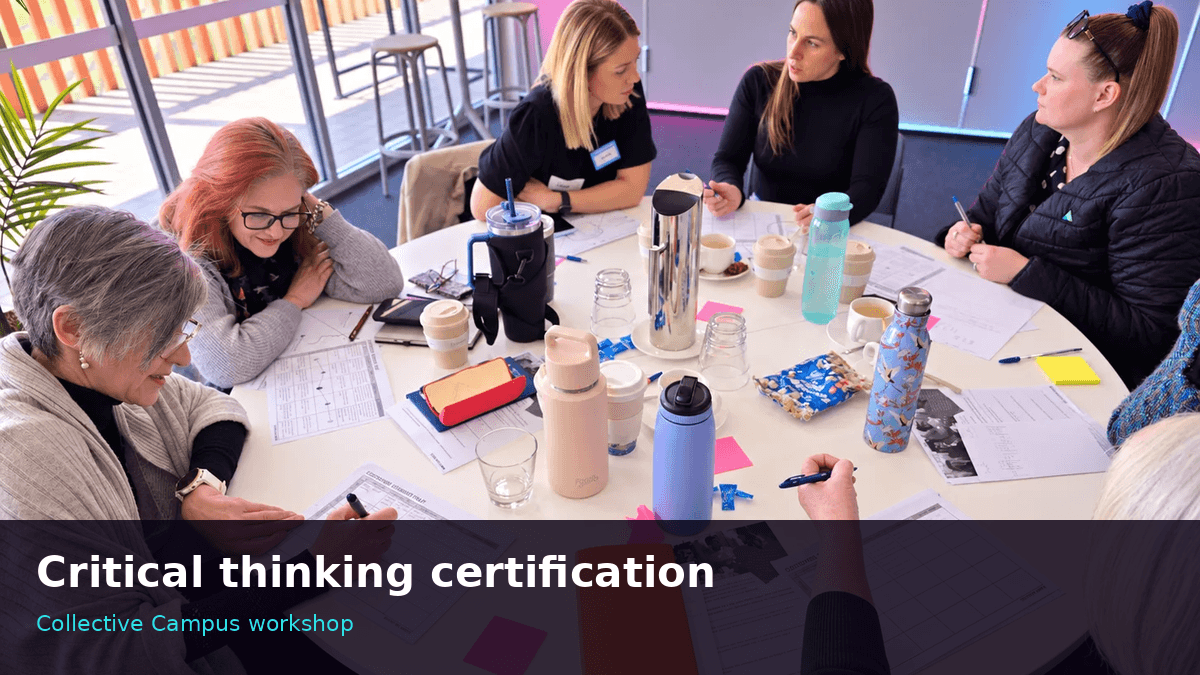
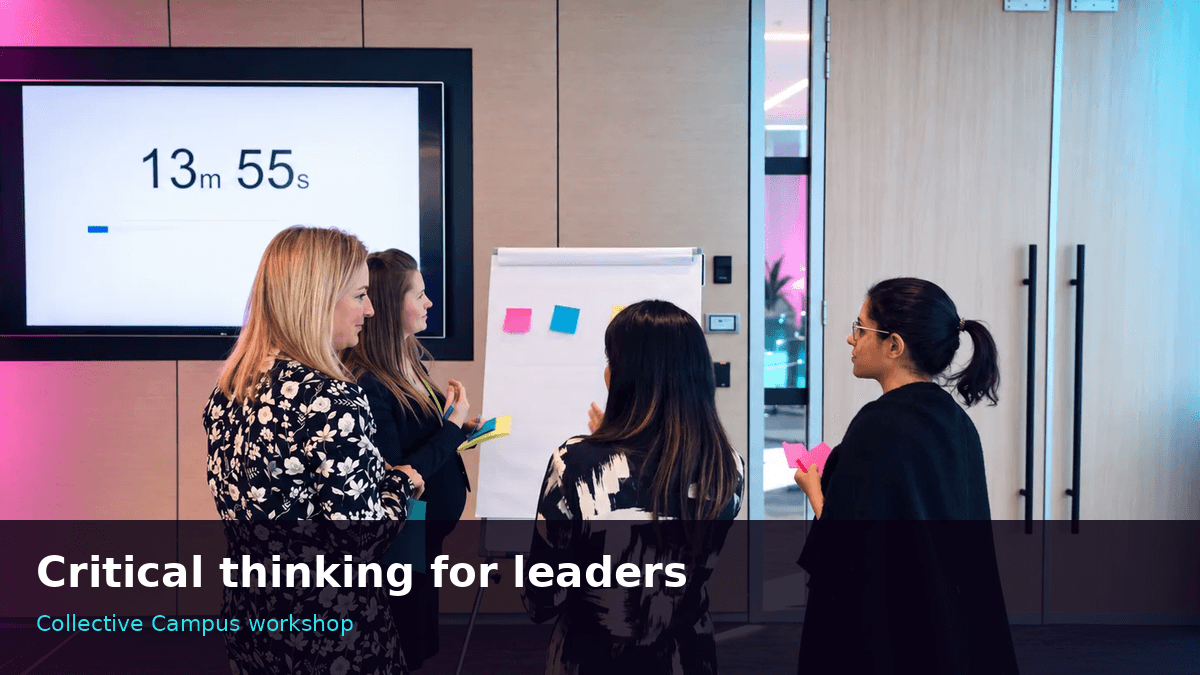
Collective Campus has been running capability building programs for organisations across the globe since 2015. The critical thinking workshop is one place a team can practise on a live decision, with the AI tools they already use. The people who will be asked to explain the choice need that practice at least as much as the people who write the prompts.
What to ask a training provider
The useful question, including when you ask Collective Campus, is what the team will bring to the session. If the answer is a case written for the course, and your people cannot bring the decision they are making, you are buying an introduction to the ideas. An introduction is a fair purchase when that is what you wanted. It leaves the team's next real decision unchanged.
What to mark on the draft
These marks make the working visible, so a colleague can follow the decision without asking the author to talk them through the meeting. They belong on the recommendation you are about to send, including when a model wrote the first pass.
- Every material claim has a source beside it, and a colleague can open that source.
- The assumption that would make the recommendation wrong is named, along with the person who will test it.
- Any promise in a passage a model wrote has been checked against the policy or the record that governs it.
- A colleague can see which lines were checked against a source and which were left as the model wrote them.
- One person is named to explain the choice if someone questions it later.
Questions buyers ask
These questions come up once a team starts using the check on a real approval. Each answer is something you can apply to the draft you are about to send.
What is human judgement at work?
It is the working a person can show for a choice that was not obvious: the facts they trusted, the assumption that would make the choice wrong, and who will explain the result. A colleague should be able to find that working on the draft before it is sent.
Can a team use AI and still make its own decisions?
A team can take the draft from a model and still own the decision, provided someone who understands the subject writes the explanation. Gallup's finding on manager support describes how often people use the tools. The responsibility for the choice stays with the person who approves it.
What should someone check before sending a reply a model drafted?
The promise should be read against the policy and the account before the reply goes. A calm sentence can offer a credit, a refund or a timeline the company is not in a position to give, and a helpful tone makes that line easy to miss. The person who knows the account is the right person to do that read.
Why do search pages also use the spelling judgment?
Judgment is the American spelling. This article and the workshop use the Australian spelling, judgement, and the meaning is the same.
Where can a team practise this?
A team can practise on a live case in critical thinking training, while the choice can still be changed. The useful brief names the decision and the person who will explain it afterwards. A session that uses only a case written for every client teaches the vocabulary and leaves the team's own decision untouched.
Is this only for people who write prompts?
Often the person who has to explain the choice never opens the model. If the training is booked only for the people who write the prompts, the meeting still has nobody ready to explain the decision.