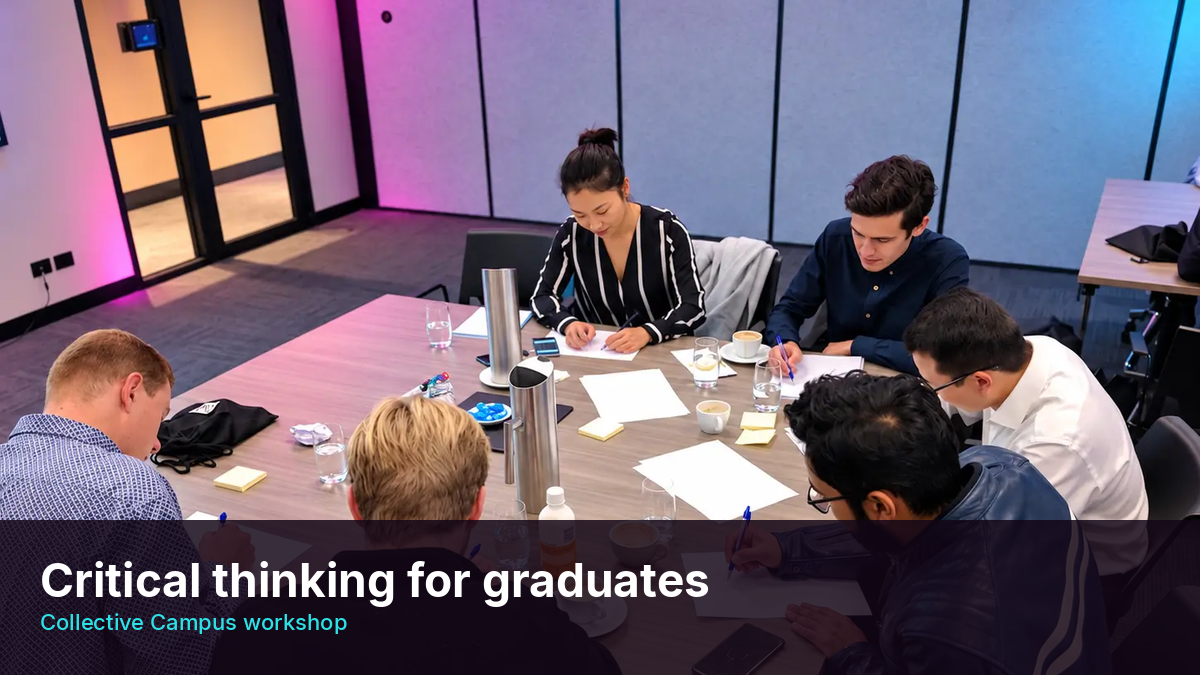
If you run a graduate intake, or you review the work new starters send up, critical thinking belongs in the program you build for that cohort. Graduate program leads, learning and development teams, and the managers who read a first draft before it goes any further all need the same standard. The practical question is how a first-year cohort learns to check a confident answer, including an answer that began as an AI draft, and how you can tell a useful workshop from a public problem-solving course or a university short course.
People joining an employer intake are often quick with the tools. Many of them have already spent a degree with a model open beside the reading, and they can produce a tidy paragraph faster than the colleagues who will review it. The practice they have usually had less of is checking: opening the source, testing the figure, and leaving a note so the reviewer can see what was checked. That check is a habit you can build in the program, before a client or a credit committee sees the page.
Why a graduate intake needs the check now
A new starter who can get a first pass back in seconds will use that speed, and you should want them to. The risk sits in the next step, when a paragraph that reads well is sent on without anyone opening the source.
A citation can look formal and still point nowhere, and a percentage can arrive with a decimal place and no publisher. A suggested next step can offer a customer something the policy does not allow. You will not catch those errors by reading the paragraph for tone. Someone has to open the source, and a first year of work is a sensible time to make that check a normal part of handing a draft up.
NACE's Job Outlook 2026 Spring Update, published on 20 April 2026, reports that employers see communication, teamwork, professionalism and critical thinking as the career-readiness skills that matter most for new graduates. Most of those employers give new graduates high marks for teamwork. They are less impressed with communication, professionalism and critical thinking. The survey ran in the United States from 12 February to 17 March 2026.
Australian supervisors, asked about graduates they actually manage, still rate most of the work highly. The 2025 Employer Satisfaction Survey from the Quality Indicators for Learning and Teaching program asks the direct supervisor of a recent higher-education graduate.
In 2025, overall satisfaction was 84.2 per cent. Satisfaction with technical skills was 94.0 per cent. Satisfaction with foundation skills, which the survey describes as general literacy, numeracy and communication together with the ability to investigate and integrate knowledge, was 93.3 per cent. Satisfaction with employability skills, described as the ability to perform and innovate in the workplace, was 86.2 per cent.
Supervisors rate employability skills lower than technical skills. The specialist rating is high, and the lower mark is on performing with that skill in the workplace, which is the part a program can rehearse.
Future Skills Organisation put a similar point to the Senate inquiry into Australian university graduates, in a submission dated 19 May 2026. The submission says employers report that many graduates are not job-ready, with gaps in practical capability, digital and AI fluency, communication and professional judgement. In the accounting example, the submission says graduates are expected to interpret and validate outputs a system has generated, to exercise professional judgement over automated processes, and to apply cybersecurity awareness.
For a program lead, the task worth taking from that submission is the one it names. Someone has to decide whether a system output can be relied on. A graduate program is where that decision can be practised before the output is a client file.
The same pattern shows up when you ask the new starters. KPMG in the United States surveyed 361 winter interns in February and March 2026 and published the results on 25 March 2026. Ninety-four per cent identified as Gen Z. The concern they named most often about using AI was over-reliance that limits critical thinking and decision-making, at 43 per cent.
Asked which skills they most wanted to show as entry-level employees working alongside AI, they ranked critical thinking and problem-solving first. Nearly 30 per cent of their current assignments already involved some AI assistance, and 78 per cent said they felt at least somewhat prepared to work alongside the tools. The same cohort is reporting both fluency with the tools and a worry about over-reliance. A program that only adds another tool, or that talks about the cohort as careless, misses what these interns are already saying.
Who counts as a graduate
Graduate means an employer intake. It is the cohort your organisation hires from university or from another early job, usually people in their first year or so of work, plus the managers who review them and the lead who builds the program around them. A postgraduate class at a university, and a short course a student books to finish an assignment, use the same word for a different person. Search results mix those two meanings, so a workshop listed for essay structure will not tell you whether your intake can bring a live file, and a university skills page will not know your AI policy.
If your organisation uses graduate for a development year that includes people with a few years behind them, the same questions still apply to anyone whose work is reviewed before it leaves the team. The case that needs its own design is the new starter. The first months are when the checking habit is either built into the way work is handed up, or left as a correction a manager has to write in the margin every time a draft arrives. Later, the same correction is harder, because tidy drafts have already been accepted without anyone asking what was checked. A graduate program lead, a learning partner and the manager who reads the draft can all use the same standard, and the manager is the person the standard has to satisfy.
Fluency with tools, and the habit of checking
Being quick with a model and being in the habit of testing what comes back are different skills. A person can be strong at drafting and still be new to the check, and the check is something the program can build. Graduates often find a faster way to draft a note, line up a comparison or tidy the points from a meeting, and you want that speed. The trouble starts when it meets a file a client, a regulator or a senior manager will rely on, and nobody has marked which lines were checked.
You can see the difference on an ordinary page. A graduate in a retail team prepares a one-page note on a supplier who has missed two deliveries. The model has produced a clear summary and a suggested penalty.
The summary is fit to send on if the dates match the purchase orders and the penalty is one the contract allows. It is unfit to send on if the penalty was invented by a prompt that said "be firm", or if a delivery date in the note does not match the warehouse record. The graduate who has practised the check will mark the sentence taken from the model and the sentence confirmed against the order. The graduate who has only practised prompting will send the page because it reads well, and the buyer who receives it will treat the penalty as the company's position.
The program should be built around that difference. The check belongs on the tasks where a confident error is expensive, and the low-stakes draft can go once the facts are visible. A session that tells every graduate to distrust every output will be ignored by the end of the first rotation, because most outputs on a quiet task are fine. A session that never shows a fabricated citation will leave the expensive case unpractised.
When to trust, verify, challenge or escalate
Four calls cover most of what a new starter meets in a normal month, and they are worth teaching on a file the cohort recognises. Naming the four calls on a slide is not enough on its own, because people forget the labels by the next rotation unless they have used them on a file they recognise.
Trust, after a small check, fits a low-stakes draft whose facts the graduate can see. A model rewrites an internal handover so the next person on the rotation can follow the open tasks. The names, dates and unfinished items match the notes from the meeting. Nothing in the draft promises a client an outcome or a date the team has not agreed. Sending it, after a glance from the person who was in the meeting, is a reasonable use of the tool, and the graduate should be able to say why they trusted it.
Verify fits anything that cites a source, a figure or a rule. A research note for a manager in a professional firm lists four papers and a market size. Each paper has to exist, has to say what the note claims, and has to be current enough for the decision in front of the team. The market size needs a publisher and a year beside it. A citation that looks perfect and does not resolve is a reason to stop, and a reason to tell the manager what was removed.
Challenge fits a recommendation that depends on an assumption. A graduate in an operations team builds a comparison of two logistics providers. The model draws a tidy table and shades a preferred row.
The table is only as good as the volumes, the contract length and the service levels that were typed in. The useful challenge is to write the assumption that would flip the preference, and to ask whether the manager would sign that assumption. If nobody can name that assumption, the shaded row stays with the team until someone writes down what would make the recommendation wrong.
Escalate fits uncertainty about the tool, the data or the consequence. A client has sent a pack of board papers ahead of a workshop. A model would summarise them in a minute.
The graduate's question is whether that material is allowed in the tool the organisation has approved, and what the policy says about client information. If the answer is unclear, the work waits until a manager, or the person named in the policy, says yes. New starters hesitate when they think the question will make them look slow, so the program has to treat the early question as the competent move.
The cohort needs to practise all four calls on your material. A published example can introduce the names of the four calls, and the files your people already work on show which call belongs after the rotation changes. If a provider brings one fictional company to every client, the session has not been built around your intake.
Checking sources, figures and citations
A reviewer should be able to open what the page relies on. People often agree with that standard in a planning meeting, and then skip it when a draft already sounds complete and the reviewer is short of time. For a graduate, it can be small enough to use without a second course.
Every material claim needs a source a colleague can open. A figure needs a label that says whether it was taken from a system, estimated or assumed. A citation needs to have been opened, so the sentence it supports is a sentence the source actually supports.
Consider a slide a graduate prepares for an internal planning meeting. One bullet says a competitor grew revenue by a precise percentage last year. The percentage came back from a model that was asked for a recent figure, and it arrived with a confident decimal.
The check is to find the competitor's own report, or a named data series, and to put that name on the slide. If the search does not turn up the number, the bullet comes off. The meeting needs the publisher of the figure written on the slide, beside the percentage.
The same problem shows up when the draft quotes a case, a section of an Act, a regulator's guide or a clause in a precedent. The quote is indented and looks official, and someone still has to find the source and read the lines around the sentence that was lifted. You cannot tell from the formatting alone whether a summary reverses the finding, or whether the citation exists. The graduate's job is to make that catch routine, so it does not depend on who happens to be reviewing that day.
Figures need the same treatment as quotes. A model that fills a gap will often invent a middle value rather than say it does not know, and in a pricing comparison that middle value can become the number the meeting debates. Say whether the figure is last year's actual from the finance system or an estimate the graduate typed, and say what change in volume or price would make the recommendation wrong. A reviewer can work with a labelled estimate. An unlabelled figure leaves the meeting debating a number nobody measured.
The same standard, applied one step later, is what a manager uses when the recommendation arrives for approval. That later review is set out in critical thinking for leaders and managers. For a graduate, the standard starts on the note they hand up, before anyone has been asked to sign.
What can go into a tool
The organisation's AI policy is the document that answers this. A graduate program should use that policy, rather than a generic warning that could have been written for any employer. People need to know which tools are approved, which kinds of information may be pasted, and who to ask when a file sits on the boundary. Client documents, unpublished numbers, health information, staff records and anything a contract marks as confidential are the usual boundaries. The exact list is yours, and a session that substitutes a different list is teaching the wrong rule.
A worked contrast helps more than a poster of prohibited items. A graduate wants help turning a long customer email into three points for a supervisor. If the email is ordinary correspondence and the approved tool is cleared for that kind of text, the task can proceed, and the three points still get checked against the email before they are sent up.
If the email attaches account numbers, a medical claim or a draft contract the policy excludes, the graduate uses another path. That path might be notes taken from the parts that are allowed, or a question to the manager before anything is pasted. The practice is telling those two emails apart on a normal afternoon, and being able to explain the choice in a sentence.
Managers who review the work need the same map. A margin comment that says to be careful with AI does not tell a new starter which file was allowed. A short line in the team handover, naming the approved tool and the kinds of material that stay out of it, gives the reviewer and the graduate one rule.
When the rule is still being written, say that plainly in the program. People can practise the calls you are willing to make now, and a graduate who is unsure should ask before pasting. A program that treats that early question as competent will hear it while the file is still on one person's screen.
Leaving a record a reviewer can follow
The check helps the graduate, and it helps the person who has to sign, send or stand behind the work. A useful record is short enough to write on the draft. It says what was taken from a model, what was checked against a source, what was assumed, and what is still uncertain. A manager can then spend time on the uncertain line, instead of redoing the page to discover whether anyone looked.
You can ask for that record in a form the team already uses. A comment, a footnote, or three lines at the top of the draft are enough. A note might read: drafted with the approved tool; citations one and two opened and they match the claim; citation three removed because it did not resolve; the growth figure is from the client's latest annual report, with the page named; the recommended option assumes volume stays within 10 per cent of last year. A reviewer can follow that without booking a meeting. A draft with no such note leaves the reviewer to guess which lines were checked, and an error that reads cleanly can still be signed.
This is also how you coach, and the coaching is the part that survives after the session. If the note shows the graduate checked the wrong source, you can correct the source and the person can see the miss. If the note is missing, the first conversation is about the missing note. A program lead can compare a handful of drafts from the month after the session with drafts from the month before, names removed where the policy requires it, and ask whether the check is visible. If the later drafts still look like the earlier ones, people can name the check, but the way work is handed up has stayed the same.
How graduate training differs from the teams workshop
Critical thinking training is for people who already make the decisions. A team brings a recommendation it is about to send and works through it with someone there to test the decision. A graduate intake is earlier in the process, because the new starter is usually preparing the material and someone else approves it.
The habits overlap with the teams workshop, and the brief for an intake is the draft that someone else will approve. A session designed for managers who own the call will spend its time on how to run the discussion and how to hear a disagreement before the decision is locked. A session for an intake spends its time on the four calls, on citations and figures, and on when to take a file to a manager.
Many organisations book both, with the intake first and the reviewing managers in their own session. Margin comments stick when the reviewer asks for the same record the graduate was taught to leave. If the cohort learns to mark assumptions and the manager never looks for the mark, the cohort will stop marking within a rotation. The scoping conversation should cover whether those managers will ask for the same record.
How graduate training differs from a public course
A public critical thinking course has to teach people who do not share an employer, a policy or a file. The case has to be one all of them can follow, so it is written for the course. That can be a fair way to learn the vocabulary and to hear how other organisations talk about the same problem. The next file your graduates produce is not part of that course, because the participants could not bring it, and the rule about what may be pasted was not your rule.
When you ask a provider whether the cohort can work on your material, listen for a specific answer. A useful reply names the kind of work your graduates do and how the scenarios will be written from it. A reply that describes a standard case, with a fictional company and a fictional data set, is a different product. An introduction can be a fair purchase. The first live draft after the course will look different only if someone inside your program carries the method onto that draft and the managers ask for it.
How graduate training differs from a university short course
Universities run critical thinking classes for their own students, often as academic skills support or as a short course with the university's assessment. Those courses serve the student who enrolled.
Your AI policy, your clients and the manager who will read the work next week sit outside what that class is built to cover. A postgraduate workshop listed by a university is a common result when someone searches for graduate critical thinking. On a university page the word graduate means the student, and on your brief it means the employee you hired.
The record at the end of a course is a separate question from the practice, and it is worth keeping the two apart in the business case. A university credential is issued by the university, under rules the university has written down. A vocational unit on the national training register is recorded by a registered training organisation, and the comparison of that kind of record with a provider's own certificate is set out in critical thinking certification options in Australia. A certificate a provider issues in its own name can be fair evidence that the person completed the work that provider set. Any claim that a later institution will treat it as credit has to be on the provider's page, or in writing from the institution, before you put it in a proposal.
For an employer intake, ask what the person will do differently on your work. The name on a certificate matters when you need a formal record for a development plan, and the draft the person hands up that week still has to be checked. If a provider leads with the certificate and cannot describe the task the graduate will practise, you do not yet have enough to put in a proposal.
Questions to put to any provider
Ask these before you recommend a provider, including when you ask Collective Campus. A useful reply names your intake and the work. If a brochure only describes the product, it has not answered your questions about the intake and the work. Keep the written reply with the proposal, so the person who approves the spend can see what was promised.
- The work in the session comes from your organisation, including the kinds of drafts your graduates already produce, and your AI policy is one of the documents the scenarios follow.
- Managers who review graduate work can take part, either in the same booking or in a session of their own, so the record they ask for matches the record the cohort is taught to leave.
- Any certificate is described as the provider's own certificate, or as a qualification issued by a university or a registered training organisation, and the page you are shown is the page that says which one it is.
- The provider can explain what a graduate has to produce before a certificate is issued, in words a colleague could repeat, including whether the work is a real decision from the person's own job.
- Most of the time is spent on checking, challenging and escalating tasks that resemble the intake's work, and people leave with a way to note what they checked.
- The provider can say what should look different in the way a draft is handed up afterwards, and what you could look at a month later to see whether that difference is there.
If a provider cannot answer these questions from their own page while sitting with you, you do not yet have enough for the business case. Stopping at that point saves you from finding, after the cohort has been through the session, that every client received the same case.
Where Collective Campus fits
Collective Campus has been running capability building programs for organisations across the globe since 2015. Critical thinking for a graduate intake is one part of that work. Critical thinking training for graduates is the program for new starters and for the leads who run the intake. The cohort practises on scenarios drawn from the organisation's own work, including what to do with an AI draft: when to trust it after a check, when to verify a source or a figure, when to challenge an assumption, and when to escalate because the tool, the data or the consequence is unclear.
Graduates who complete a Collective Campus program can earn Certified Critical Thinker, Collective Campus. They earn it on a real decision from their own work, after they have completed the program. It is a Collective Campus certificate, assessed by Collective Campus, and it is only available to people who complete a Collective Campus program. The detail of how that assessment sits inside the program is on the critical thinking certificate page.
Critical thinking training remains the workshop for a team that already makes the decisions, if that is the brief you have instead, or as well as the intake. A short look at what that critical thinking session covers is the critical thinking quiz. The longer practical note, for people who want the checks written down before they enquire, is the guide to critical thinking and human judgement.
The part a graduate program is there to change is the judgement on the draft, and the record that lets a reviewer see that judgement. A broader leadership program for people who already manage starts from the teams workshop instead.
What to bring to a scoping call
A scoping call goes better when you bring the intake, the work and the policy. The intake means which functions the cohort sits in, and what those graduates actually produce in the first months: research notes, customer summaries, models, briefs, or something more specific to you. The work means a sample, with names and client details removed where the policy requires it, so a scenario can be written from something real rather than from a guess about your industry. The policy means the AI rules you already have, including which tools are approved and what must not be pasted.
If the policy is still being written, say so. A session can use the decisions you are willing to make now. It should not invent a rule and then teach it as if you had signed it.
You need one person who knows what good looks like when a graduate's draft arrives, because that person is who the practice has to satisfy. If they can join the scoping conversation, the scenarios will be closer to the review they actually run. If they cannot, ask them afterwards whether the scenarios still sound like the work. If the reviewing manager does not recognise the case, people can enjoy the session and then go back to the drafts they were already writing.
Questions buyers ask
A few questions come up once a graduate program lead starts comparing providers. The answers are concrete enough to take into that comparison.
What does critical thinking add to a graduate program?
It adds a practised way to decide what to do with a confident output, including an output from an approved AI tool, and a short record so the reviewing manager can see what was checked. Technical rotations still teach the subject matter of the job, and the habit to add is testing the draft before it is handed up.
Are new starters being singled out as weak thinkers?
Checking is treated as a habit that client work and internal sign-off demand, and fluency with tools is treated as something many new starters already bring. The practice exists so a manager can rely on the page, and so the graduate can show their working. A cohort that is quick with the tools is the cohort you want in the session.
How is this different from a session on the AI tools?
A session on the tools is practice with the systems the organisation already allows, on a workflow people already have. Critical thinking for an intake is the judgement about when to trust, verify, challenge or escalate an output, and how to leave a note. Many programs need both, because the two sessions answer different questions, and booking one still leaves the other to arrange.
Can the managers of new starters take part?
The people who review graduate work can take part, so the record they ask for is the record the cohort learns to leave. A separate session for those managers is often the cleaner booking, because their decisions are about approving a recommendation, and a new starter's decisions are about preparing one.
What should people be able to do afterwards?
They should be able to say which call a task needs, show the source behind a material claim, say what must not go into a tool under your policy, and leave a short note a reviewer can follow. Where a Collective Campus certificate is part of the program, it sits on a real decision from the person's own work, after they complete the program.
What belongs in the first conversation with a provider?
Bring the intake, the work graduates actually produce, and the AI policy. A sample with sensitive details removed is enough to show the shape of the work. If a provider cannot say how your sample would change the session, you still only have a description of the product, and you do not yet have a booking.
When is the teams workshop the better booking?
When the people in the booking already own the decision, and the need is to test a recommendation before it is approved. The graduate program is the better booking when the people preparing the material are in their first year or so, and the need is the habit of checking before the draft is handed up. Some organisations book both in the same year, because the two groups are doing different jobs.