
For government and the public sector
Building high-performance teams and optimising service delivery for the public sector
Innovation, design thinking, customer experience and AI training for councils, government agencies, water utilities, public health services and universities.
- Councils and agencies
- Water utilities and health services
- In person or remote
Public sector clients
Councils, state health, water utilities and more
Seventeen public sector organisations across Australia and Asia. Each logo links to its published case study.
Local government







Water utilities




State health

Public universities

International

In their words
What public sector leaders say about innovation and CX training
Local government
We have developed a great partnership with Collective Campus and their dedication to improving our customers experience is evident in the quality of work they delivered. The work they have led has ranged from facilitating customer experience workshops to the development of customer personas to co-designing a local government first community program for start up's in partnership with other Councils. Because of the successful delivery of this work - customer experience is now part of our organisations vernacular and included in the foundation of all service design so we are truely able to put the customer at the centre of all we do.
Feedback received, both formally and informally, has been overwhelmingly positive, Leaders have admitted to having their eyes opened and thinking challenged, seeing this as an opportunity to be more innovative in how we respond to and add value for our customers. Shay brings great experience, knowledge, ideas and energy to his facilitation. It's been a great experience partnering with Collective Campus and being part of these workshops.
Fostering a culture of innovation is one of our key objectives at Yarra Ranges. This led us to engage Collective Campus for a one-day session on Design Thinking. As a result, the Innovation team was able to apply these principles to innovation initiatives while aligning with the rest of the organisation.
Public sector
Capability building for councils, agencies and public bodies
Councils, agencies, utilities and public universities are asked to deliver better services with the same or fewer resources. The difference usually comes down to the capability of the teams doing the work.
Collective Campus builds that capability. Since 2015 we have run design thinking, customer experience, innovation, lean startup and agile workshops, AI programs and startup programs for public sector organisations across Australia and Asia.
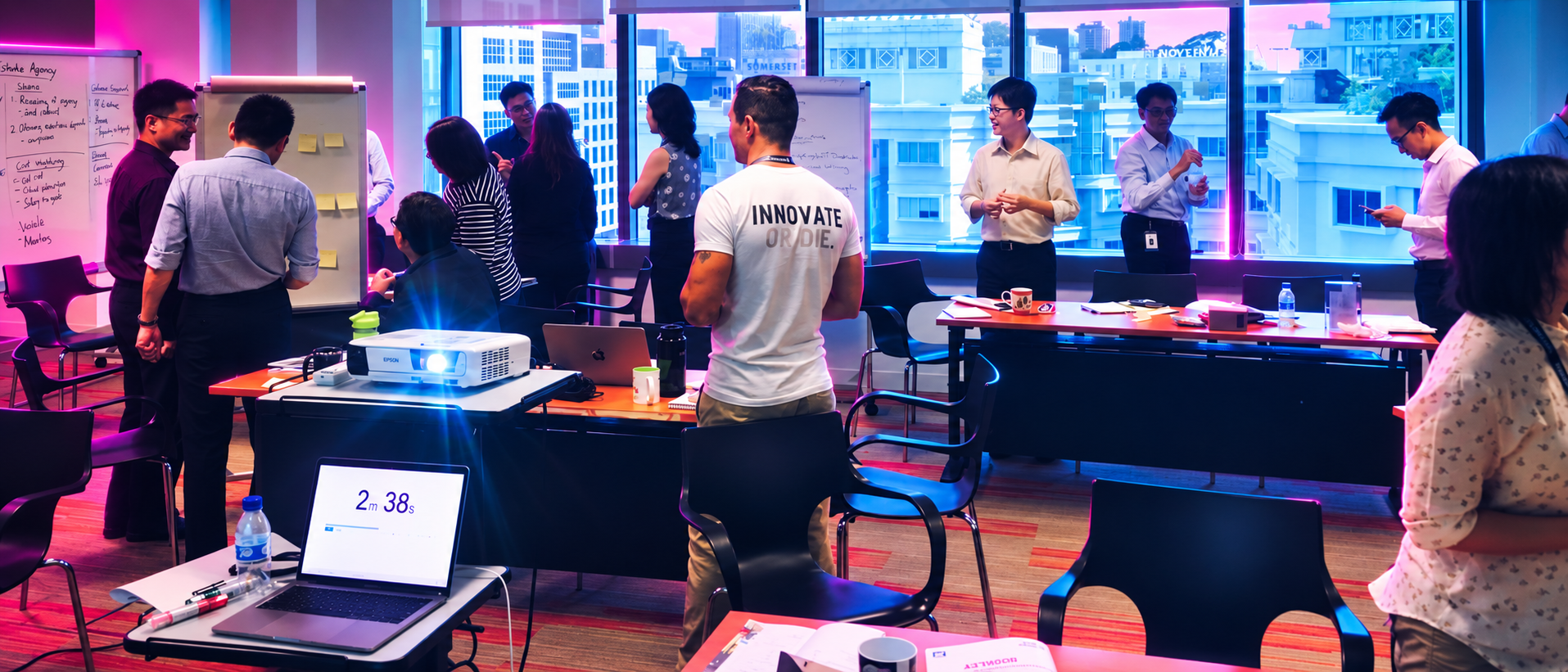
Every workshop is hands-on and built around a real service or process your team owns. The aim is a team that can keep using the method after we leave.
- 17 public sector clients, each with a published case study
- Councils in Victoria, New South Wales and South Australia
- Water utilities, a state health service, public universities and international government programs
Innovation
Innovation training for the public sector
Public sector innovation is not about copying a startup. It is about a team that can spot a better way to deliver a service, test it cheaply, and make a case that survives a council meeting or an executive committee.
That takes capability, not a one-off event. A team needs a shared method, a shared language, and enough practice on real work that the method sticks after the facilitator leaves.
Since 2015, Collective Campus has run innovation training with councils, water utilities, a public health service and public universities. The pattern that works is the same each time: start from a real problem the organisation already has, teach the method on that problem, and leave the team with something it can act on.
Why public sector innovation is different
Glen Eira City Council described the challenge well. With so many possible initiatives, knowing where to start and what will add genuine value is hard for any traditional organisation, and harder still in the public sector, which carries constraints the private sector does not.
Public teams answer to residents, elected members, regulators and auditors. Budgets are set in cycles. A failed experiment can become a headline. That does not make innovation impossible. It means the method has to be disciplined about risk, evidence and accountability from the start.
Start with an honest assessment
Before Glen Eira invested in training, it asked Collective Campus to assess its resources, processes, values and systems. That meant speaking with employees across vertical and horizontal lines, and reviewing key documentation from across the organisation.
The output was an innovation assessment report with prioritised recommendations, so decision makers could choose where to invest time and money to shift culture. Glen Eira then made investment decisions on culture and capability informed by those results. See the Glen Eira innovation assessment.
Give idea winners a real pathway
Ideas challenges are common in government. The problem is what happens next. City West Water wanted to give the teams that won its internal ideas challenge a pathway forward.
The workshop covered corporate innovation fundamentals, design thinking and lean startup. Teams mapped business models, defined key assumptions and built prototypes to test appetite, showing how quickly a public team can move with the right conditions and framework. Read the City West Water case study.
Innovation in public health
South West Hospital and Health Service in outback Queensland hand-picked leaders from across the organisation to drive change and innovation. Collective Campus combined an innovation crash course, covering lean startup, agile and the dynamics of innovation inside large organisations, with a design sprint on improving the patient experience.
Participants generated over 200 ideas to improve the patient experience. More importantly, they learned how to prioritise ideas and build low-fidelity prototypes to test the assumptions underneath them, so they would not stall between idea and execution. Read the South West Hospital and Health Service case study.
Innovation beyond Australia
Singapore Pools, established by the Singapore Government, asked Collective Campus to help its people become more creative and generate better ideas. The tech crash courses covered ideation methods, innovation theory, business model development and emerging technology. Across the cohorts, participants generated over 150 ideas in 30 minutes. Read the Singapore Pools case study.
Design thinking
Design thinking for the public sector
Design thinking gives public teams a repeatable way to understand the people they serve before deciding what to build or change. It moves a team from "we think residents find this hard" to "here is exactly where, and why".
It suits government because it works on both sides of the counter: public-facing services and the internal processes behind them. It is also one of the most requested workshops from councils and utilities we work with.
Design thinking for councils
Yarra Ranges Council wanted to introduce a design thinking mindset to problem solving. Collective Campus trained the team in design thinking as a creative problem-solving mindset, the best practice tools and templates, and the behaviours needed to embed it in the culture. The team came away with a shared, end to end understanding and the tools to use design thinking in their daily jobs. Read the Yarra Ranges design thinking case study.
Glen Eira City Council wanted to learn how to prototype ideas. Its team worked through the five stages of empathise, define, ideate, prototype and test, then developed ideas, built a case for them and identified objectives and benefits. They used the method to develop big new ideas and to improve things in their daily jobs. Read the Glen Eira design thinking case study.
Design thinking for government teams in South Australia
The City of Burnside asked for a tailored, foundational design thinking session for council employees. The workshop taught the fundamentals in a way that applies to both public-facing services and internal processes.
Participants left with a working knowledge of the five steps of design thinking, and how to use them to identify problems, define solutions, build prototypes and pursue the best options. Read the City of Burnside case study.
Design thinking for water utilities
Coliban Water, a regional water corporation in north-central Victoria, wanted to give a newly formed innovation team a design thinking mindset. The training covered the mindset, the tools, the behaviours that embed it, and how the team could drive innovation internally after the workshop.
The team generated over 100 ideas to solve two key problems it had identified. Read the Coliban Water case study.
What a public sector design thinking workshop looks like
The room works on a live problem, not a case study from another country. A council might bring a permit process, a community consultation or a resident service that generates complaints. A utility might bring a field operations problem or a customer process.
The team interviews or reviews evidence from the people affected, defines the real problem, generates options, and builds a rough prototype to test. The goal is a method the team can run again without us. See the full design thinking workshop.
Customer experience
CX training for councils and public agencies
Customer experience in the public sector is service design with a resident at the centre. Residents feel the seams between teams, channels and systems. The organisation rarely sees them end to end.
Collective Campus has run customer experience programs for councils in Victoria, New South Wales and South Australia. The work ranges from personas and journey maps to training a cohort of CX champions who carry the change into their own teams.
Personas and journey maps at the City of Whittlesea
The City of Whittlesea wanted a more customer-centric approach and better journeys for its residents. Collective Campus analysed existing customer data, including reports and surveys, and developed four customer personas that gave a human face to each key customer type.
Using those personas, Collective Campus ran customer experience workshops for eight business areas: kindergarten enrolment, hard waste, building planning, animal registration, city transport and presentation, venue hire, information management and the contact centre. Each produced a shared understanding of customer types, pain points and opportunities at each touchpoint, and ideas prioritised by cost and impact. Read the City of Whittlesea case study.
Mapping two high-volume resident services
Whittlesea later asked to see two everyday services the way residents actually experience them: council rates and the damaged bin process. Both look simple from the inside but stretch across touchpoints, teams and systems.
The session walked each journey stage by stage through the resident's eyes, mapping touchpoints and pinpointing where handoffs quietly break the experience. The council left with a shared, visual picture of both journeys and a prioritised set of friction points to fix. Read the customer journey mapping case study.
CX for council leaders
Yarra Ranges Council followed its design thinking work with customer experience workshops for its leaders. In the council's own words, leaders had their eyes opened and their thinking challenged, and saw it as an opportunity to be more innovative in how the council responds to and adds value for its customers.
Liverpool City Council in Sydney's south-west wanted to learn how to create great customer experiences through customer-centric design. Its team learned to step into customers' shoes and see the council from their perspective. Read the Liverpool City Council case study.
Training CX champions
The City of Marion in Adelaide appointed new CX champions from across the organisation and wanted them ready to lead. The program covered why customer experience matters for councils, case studies of leading CX, how to identify customers, how to build personas and journey maps, and how to champion change inside government.
The champions walked out with the skills to tackle the customer experience challenges ahead in their community. Read the City of Marion case study.
What changes when CX sticks
At Whittlesea, customer experience became part of the organisation's vernacular and the foundation of its service design. That is the real goal of CX training in the public sector: not a one-off workshop, but a shared habit of starting from the resident. See the full customer experience workshop.
What we run
Workshops and AI programs for public teams
Hands-on, built around a real service or process your team owns. In person or remote. Each link is the full program.
Design thinking
A method teams can run again on public-facing services and internal processes.
Explore →
Customer experience
Map a live resident service, rank the friction and leave with a fix.
Explore →
Psychological safety
The candour people need to speak up and learn, without lowering the standard.
Explore →
Critical thinking
Practise judgment on live work, so people keep ownership of the decision.
Explore →
Lean startup and product sprint
Test ideas fast before they become funded projects.
Explore →
Agile
Ship in small steps and get from A to B faster.
Explore →
Productivity
Protect time for deep work on the services that matter.
Explore →
AI training
Put AI to work in the day to day, on the tools your teams already have.
Explore →
AI design sprints
From AI literacy to outcomes. Teams take real problems, build with AI, then pitch.
Explore →
AI governance
Acceptable use, risk and accountability, written for your agency.
Explore →
AI champions
A champions cohort, and briefings for executives.
Explore →
AI programs
AI training for the public sector
AI is one part of the capability public teams need, not the whole of it. The same disciplines that make design thinking and CX work apply here: start from a real service, keep a human accountable for the decision, and be clear about what data goes where.
Our AI programs for government and public bodies sit alongside the workshops above. They focus on practical use on the tools your teams already have, and on the governance that lets an agency say yes with confidence.
AI training for government staff
Hands-on AI training puts AI to work in the day to day, on real tasks and approved tools. Staff practise on work they already do, and learn where the output needs checking before it reaches a resident or a decision maker.
Glen Eira City Council has already explored this ground with Collective Campus, through a digital awareness workshop on automation, AI and data in local government. Read the Glen Eira digital awareness case study.
AI governance for agencies and councils
Public bodies hold resident and customer records that cannot leave approved systems. AI governance sessions help leaders write acceptable use, risk and accountability rules for their agency: what staff may enter into an approved tool, what stays in the records system, and who answers for it.
AI design sprints and AI champions
AI design sprints take teams from AI literacy to outcomes: they take a real problem, build with AI, then pitch. The AI champions program builds a cohort of people inside the organisation who help colleagues adopt AI well, with briefings for executives.
Ways of working
Lean startup, agile and productivity training for government teams
Public teams are often asked to move faster without more budget. Lean startup, agile and productivity methods help, as long as they are taught in a way that respects public sector constraints.
Lean startup in a regulated public body
Water Corporation in Western Australia wanted its product and innovation team able to apply lean startup in a regulated, public body. The workshop covered running lean startup in large, regulated organisations, case studies from the public sector, innovation fundamentals, and how to increase speed.
The team came away motivated to take actionable next steps on existing projects, because it could now see how to apply lean startup despite the usual public body encumbrances. Read the Water Corporation case study.
Agile for public universities
Deakin University wanted its data and business analysts trained in agile, so they could get from A to B faster and deliver better outcomes. The bootcamp covered the difference between waterfall and agile, and how to run an agile project with backlogs, stories, estimation and agile meetings. The result was a team better able to deliver features rapidly, with a stronger customer focus. Read the Deakin case study.
Market validation for university entrepreneurs
RMIT engaged Collective Campus to run market validation training for its Activator entrepreneurship program, with students, alumni and teachers taking part. The session covered defining and prioritising key assumptions, prototyping and testing, customer acquisition, and key metrics. Participants arrived with an idea and left with a roadmap to test it quickly and cheaply. Read the RMIT Activator case study.
Psychological safety, critical thinking and productivity
Better services also depend on how a team works together. Psychological safety builds the candour people need to speak up and learn, without lowering the standard. Critical thinking practises judgment on live work, so people keep ownership of the decision. Productivity helps teams protect time for deep work. Lean startup and agile help them test ideas fast and ship in small steps.
Startup programs
Startup programs for councils, utilities and governments
Sometimes the fastest way to solve a public problem is to find someone who has already built part of the answer. Collective Campus has run 12 startup programs, including programs designed for councils and water utilities.
Springboard: councils sourcing startups together
Local government faces demanding and complex community expectations with limited resources. Three Victorian councils, the City of Casey, the City of Ballarat and the City of Whittlesea, joined Collective Campus to invite startups and scaleups to solve shared challenges in transport, waste, and health and wellbeing.
Springboard received over 200 applications from startups and scaleups around the world. Eleven were invited to pitch, and several were selected to partner with the councils. Read the Springboard case study.
WaterWorks: utilities partnering with global startups
Melbourne Water and City West Water engaged Collective Campus to solve internal challenges by partnering with global startups and scaleups. The challenges covered monitoring large areas of rough terrain for targeted maintenance, driving behaviour change in water use, and forecasting water demand more accurately.
WaterWorks attracted over 130 applications. Fourteen startups pitched to both utilities and representatives from peak bodies in the water industry, and several were selected to pursue commercial engagements. Read the WaterWorks case study.
K-Startup Grand Challenge: a government program reaching Australia
The K-Startup Grand Challenge is a startup program organised and financed by the Korean government. In 2020 it had very few applications from Australia and New Zealand, and partnered with Collective Campus to connect with the local ecosystem.
Collective Campus promoted the program to over 3,000 Australian and New Zealand startups in 2020, producing more applications from the region than ever before. In 2021 it reached over 5,000 startups, application numbers grew again, and 13 Australian and New Zealand startups were shortlisted to pitch. Read the 2020 and 2021 case studies.
Sectors
Government training across the public sector
The public sector is not one organisation. Each part has its own pressures, and the workshop should reflect them.
Council training
Councils deliver dozens of services to residents, from kindergarten enrolment to hard waste. Council training works best when it starts from one of those services. Our council clients span Victoria, New South Wales and South Australia, and most began with design thinking or customer experience.
State government agencies and health services
Agencies and health services carry large, distributed workforces and high-stakes services. South West Hospital and Health Service shows what works: hand-pick leaders from across the organisation, teach the method, and apply it straight away to the patient experience.
Water utilities and government-owned corporations
Utilities are customer businesses inside a public framework. Melbourne Water, City West Water, Coliban Water and Water Corporation have used design thinking, lean startup and startup partnerships to move faster within it.
Public universities
Universities run complex operations alongside teaching and research. Deakin used agile to speed up delivery, and RMIT used market validation to help its entrepreneurs test ideas before building them.
In the room
What a public team should leave with
- One named service or process, and a shared picture of how residents or customers experience it.
- A prioritised list of friction points or ideas, ranked by cost and impact.
- A rough prototype or test for the most promising idea, with the assumption it needs to prove.
- A method and a shared language the team can use again without a facilitator.
- An owner for the next step.
About us
About Collective Campus
Collective Campus builds high-performance culture and teams for the AI world. Since 2015 we have helped organisations across Australia and Asia build capable, high-performing teams, and partner with startups to solve real problems.
We have worked with more than 100 large organisations and incubated more than 100 startups through our programs, with studios in Melbourne, Singapore and New York. Find us at collectivecampus.io.
Capability building workshops
Psychological safety, critical thinking, customer experience, design thinking, lean startup, agile and productivity.
AI programs
AI design sprints and practical AI training, plus governance, champions and leadership programs.
Startup programs
Accelerators and startup matchmaking that connect public bodies with startups able to solve their problems, including Springboard for councils and WaterWorks for water utilities.
Facilitator

Founder of Collective Campus and author of Time Rich
Steve Glaveski
The founder of Collective Campus and author of Time Rich, Steve Glaveski still personally leads flagship workshops. He started Collective Campus after roles at EY, KPMG and Macquarie Bank. He is a two-time Wiley author (Employee to Entrepreneur and Time Rich), has written for Harvard Business Review, and hosts the Future Squared podcast, with more than two million streams. He has spoken at SXSW and across Australia, Singapore, Hong Kong, the Philippines, Thailand and the US.
Public sector
Questions from public sector teams
What does Collective Campus run for the public sector?
Capability building workshops in design thinking, customer experience, innovation, lean startup, agile, critical thinking, psychological safety and productivity. AI programs covering AI training, AI design sprints, AI governance and AI champions. And startup programs that connect councils and utilities with startups that can solve a defined problem.
Which public sector organisations have you worked with?
Councils including Yarra Ranges, Whittlesea, Glen Eira, Liverpool, Burnside, Marion, Casey and Ballarat. Water utilities including Melbourne Water, City West Water, Coliban Water and Water Corporation. South West Hospital and Health Service in Queensland. Deakin University and RMIT Activator. And internationally, the Korean government's K-Startup Grand Challenge and Singapore Pools. Each one has a published case study.
Is this AI training, or broader than that?
Broader. Most of our public sector work has been design thinking, customer experience, innovation and lean startup. AI programs sit alongside those workshops, for agencies that want staff using AI well on the tools they already have, with a clear rule on what data goes where.
Can a workshop be built around one of our services?
Yes, and it works best that way. The City of Whittlesea anchored a journey mapping session on rates and the damaged bin process. Bring a live service, a known complaint or an internal process, and the session is built around it.
Do you work with councils outside Victoria?
Yes. Liverpool City Council is in New South Wales. The City of Burnside and the City of Marion are in South Australia. Water Corporation is in Western Australia, and South West Hospital and Health Service is in Queensland. Workshops run in person or remote.
Can several councils run a program together?
Yes. Springboard brought the City of Casey, the City of Ballarat and the City of Whittlesea together to source startups on shared challenges in transport, waste, and health and wellbeing. WaterWorks did the same for Melbourne Water and City West Water.
We already have an innovation strategy. Where does a workshop fit?
Glen Eira City Council started with an innovation assessment, then made investment decisions on culture and capability informed by it. A workshop is how a team builds the capability the strategy assumes it already has.
How do we get started?
Book a discovery call. Tell us the service, team or challenge you want to improve, and we will recommend the workshop, sprint or program that fits.
Tell us the service you want to improve.
Name the service, team or challenge. We will shape the right workshop, sprint or program around it.