
Home/Case studies/ASX-listed financial services group
AI Governance
ASX-listed financial services group
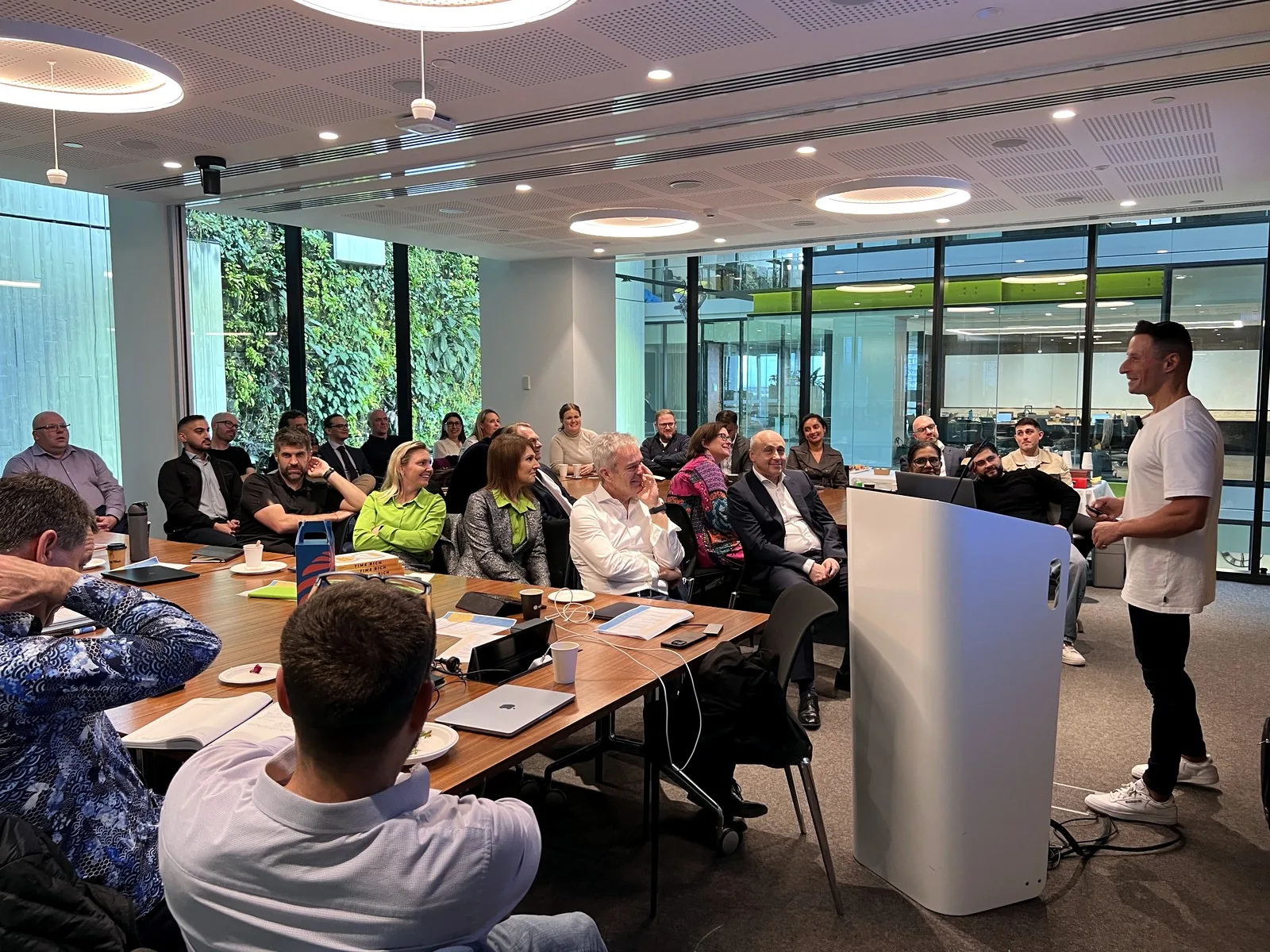
A half-day Foundations of AI Governance workshop for senior and middle managers at an ASX-listed financial services group. The brief was need to know only: what the law and the standards ask of the people who approve and oversee AI use, who owns each use, and what they put in place next.
RESULTS
- Managers left with a shared language for AI risk and a simple screen for every use in their area: refused, allowed with conditions, or allowed and watched.
- They also left with the outline of an AI policy, acceptable use rules and the fields for an AI register that feeds what executives and the board or risk committee see.
THE CHALLENGE
THE CHALLENGE
Staff across the group were already using AI. Some tools had been approved. Others had been opened in a browser because the approved path was slow or unclear. Managers tended to hear about a use in their area after it was already running.
In financial services, AI governance does not sit on its own. Directors and officers have the care and diligence duty in section 180 of the Corporations Act. Where a business is APRA-regulated, CPS 230 and CPS 234 already ask the board to oversee operational risk and information security. Neither standard uses the words artificial intelligence. Board oversight depends on what managers approve, record and report up the line.
The managers were short on time and did not share one view of what good AI governance looks like. They asked for a half day that gave them a shared language, showed where the live AI uses in their areas sat against those obligations, and ended with decisions rather than a lecture.
WHAT THE HALF DAY COVERED
WHAT THE HALF DAY COVERED
The content came straight from our AI governance guide for boards and executives, cut down to what busy managers who approve, own and oversee AI use need to know.
- Directors' duties, and the paper behind them. Section 180 asks how a director or officer informed themselves. It does not name AI. We walked through the business judgment rule and what the paper a manager prepares should show before a use is approved: what the tool does, what data it sees, who is affected, what testing was done and who stays accountable after signature.
- The standards map, where it applies. What the board approves under CPS 230, which operations are critical, whether an AI service sits under one, which providers are material, and who owns the 72-hour and 24-hour notifications. How CPS 234 treats a prompt store, a call transcript or a retrieval index as an information asset.
- Not every use is red. We put a claims or customer enquiry assistant next to an internal drafting copilot. One rating for every use teaches people to ignore the rating.
- The six essential practices. The National AI Centre's Guidance for AI Adoption as a plain agenda: decide who is accountable, understand impacts and plan, measure and manage risks, share essential information, test and monitor, and maintain human control. For each, what getting started looks like and the next step as use grows.
- The privacy rule. Personal information put into a tool is still personal information. What Australian Privacy Principles 3, 6 and 10 mean for AI in the OAIC's guidance, and why a public generative tool is a poor place for customer data.
- Misuse and the off switch. For one approved tool, how it could be used beyond the intended task and the control that catches it. For the highest-stakes use, who reviews, what they can stop and how the work continues if the system is switched off.
- Reporting up the line. What managers feed into the register and the short view executives and directors see: uses, owners, material risks, incidents and decisions required.
HOW IT RAN
HOW IT RAN
Steve Glaveski, our founder, led the session. He still leads our flagship workshops.
The format suited people with full diaries. Short inputs, then the managers worked on their own AI uses rather than made-up examples. They brought the uses they knew about in their areas, including the ones nobody had approved and the AI built into tools the group already pays for.
We said out loud which standards and guides did not apply to which parts of the business, so nobody was drilled on rules that were not theirs. We left out a catalogue of model names, a history of the technology and any claim that a template or a course certifies an organisation.
OUTCOMES
OUTCOMES
Managers left with a shared language for AI risk and a simple screen for every use in their area: refused, allowed with conditions, or allowed and watched. They also left with the outline of an AI policy, acceptable use rules and the fields for an AI register that feeds what executives and the board or risk committee see.
- The questions to ask before any use is approved: what is the use and whose outcome does it touch, what data goes in and what does harm look like, and who can stop it.
- Conditions that are concrete, such as data that must stay out of a public tool or a human review before an output is relied on.
- An agreed approach to ownership: an executive who owns AI use across the group and a named manager for each system. A committee can advise. A committee is not a name.
- Acceptable use rules covering approved tools, what must not enter a public tool, and what a person checks before an output is sent or relied on.
- Register fields: purpose, owner, data class, impact, screen outcome, control, review date, and the critical operation or information asset where relevant.
- The questions executives and the board will ask, a short report template for taking the register up the line, and a review date for the first look.
More case studies
Have a challenge like this?
Book a discovery call and we'll design a program around your goals.
Book a discovery call →