
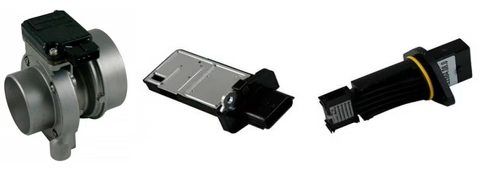
For Audi drivers, precision engineering is part of the brand’s DNA. But even the most finely tuned engine depends on small components working together seamlessly. One of the most overlooked yet critical parts is the air mass meter (also called the mass air flow sensor, or MAF ).
This compact device sits bDiscover the top 10 Audi air mass meters. Learn symptoms, compatibility tips, and why Injectronics remanufactured sensors keep your Audi performing at its best.etween the air filter and the intake manifold, measuring how much air is entering the engine. That data is then sent to the engine control unit (ECU), which calculates the correct amount of fuel to inject. When the air mass meter is working perfectly, your Audi delivers the sharp throttle response, fuel efficiency, and performance it’s known for.
When it fails, however, the consequences are immediate:
- Loss of power on acceleration
- Increased fuel consumption
- Black smoke or rich fuel mixtures
- Check Engine light illumination
- Rough idling or stalling
In short, without an accurate air mass meter, your Audi won’t perform the way it should.
⚠️ Common Signs of a Faulty Audi Air Mass Meter
Many Audi owners first notice problems with their MAF sensor when the engine feels sluggish, particularly during overtaking or when climbing hills. Others see dramatic drops in fuel economy, while workshops often diagnose excessive emissions or fault codes during servicing.
Some of the most common symptoms of a failing Audi air mass meter include:
- Erratic idling - engine revs fluctuate or stall unexpectedly.
- Poor fuel economy - more trips to the pump due to rich mixtures.
- Hesitation or surging - especially under load or acceleration.
- Black smoke from exhaust - excess fuel burning off.
- Difficulty starting - the ECU doesn’t receive correct airflow data.
Because these symptoms overlap with other issues (ignition, fuel delivery, turbo problems), professional diagnosis is essential. But more often than not, the air mass meter is the root cause .
🔍 Why Air Mass Meters Fail in Audis
Audi vehicles, like all modern cars, use hot-wire or hot-film style MAF sensors. Over time, these delicate platinum wires can degrade or become contaminated by dust, oil vapors, or fuel residues.
Some of the main causes of Audi air mass meter failure include:
- Air filter neglect - allowing dirt and debris to contaminate the sensor.
- Oil-soaked filters - aftermarket oiled filters can leave deposits on the hot wire.
- Engine blowback - fuel and oil vapors entering the intake.
- Wear and tear - the sensor’s electrical components degrade after years of use.
In turbocharged Audi engines, which rely on precise airflow measurement, even slight inaccuracies can dramatically affect performance.
⚙️ OEM, Aftermarket, or Remanufactured?
When replacing an Audi air mass meter, car owners and workshops face three choices:
- OEM (Original Equipment Manufacturer) Usually supplied by Bosch for Audi.
- Reliable but often expensive.
- Aftermarket Cheaper, but quality varies widely.
- Many fail prematurely or deliver inaccurate readings.
- Remanufactured Companies like Injectronics rebuild and recalibrate MAF sensors to match OEM specifications.
- Cost-effective, sustainable, and backed by warranties.
For many workshops, remanufactured Audi air mass meters strike the best balance between reliability and value.
🌍 The Bigger Picture: Air Mass Meters and Emissions
With governments tightening emissions standards, an accurate air mass meter is not just about performance, it’s about compliance. A faulty meter can lead to increased CO₂ output, excess particulates in diesel models, and failed emissions tests.
For fleet operators or workshops servicing multiple Audis, keeping air mass meters in top condition ensures both performance and regulatory compliance.
✅ How to Use This Guide
This article lists the top 10 Audi air mass meters based on the Injectronics catalogue . For each, you’ll find:
- Applicable Audi models and engines.
- Common symptoms when that part fails.
- Correct part numbers for remanufactured and OEM equivalents.
Whether you’re an Audi owner searching for answers, or a mechanic looking to reduce comebacks, this guide will help you identify the right Audi air mass meter for the job.
1. Audi A3 (8L1) 1.8L - AM8002 / AM8002N
- Models: 1996-2001 A3 (AGN engine)
- Why it matters: One of the most common early A3 engines, the 1.8 AGN relies heavily on precise airflow measurement for turbo and non-turbo applications.
- Part numbers: AM8002 (remanufactured), AM8002N (new OEM).
- Symptoms of failure: Rough idle, hesitation on acceleration, black smoke from exhaust.
2. Audi A3 (8L1) 1.8L Turbo-AM7117N
- Models: 1997-2003 A3 (AGU engine, chassis 8LW onward)
- Why it matters: The turbocharged variant places extra demand on the air mass meter. Even small inaccuracies in airflow measurement can reduce boost efficiency.
- Part numbers: AM7117N (new OEM replacement).
3. Audi A3 (8L1) 1.8L APP Engine-AM8023 / AM8032
- Models: 1998-2000 (APP engine, up to chassis 8LY050 → AM8023; from 8LY050 → AM8032).
- Why it matters: Subtle differences in chassis and engine codes make correct part selection critical. Using the wrong meter can trigger persistent ECU fault codes.
- Part numbers: AM8023 / AM8023N / AM80BOSN (early), AM8032 / AM8032N (later).
4. Audi A3 1.6L (AEH, AVU, BFQ engines) - AM6010CN
- Models: 1996-2003 1.6-litre petrol A3s.
- Why it matters: Popular in entry-level trims, these engines are sensitive to lean/rich fuel ratios caused by MAF sensor wear.
- Part number: AM6010CN.
5. Audi A4 (B6) 1.8T - AM80BOSN
- Models: 2000-2004 (AVJ, BFB, BEX engines).
- Why it matters: Turbocharged B6 A4s are particularly prone to fuel/air mixture issues if the MAF begins to drift out of spec.
- Part numbers: AM80BOSN (covers multiple 1.8 turbo engines).
6. Audi A4 (B6/B7) 2.0 TDI-AM80BOSN
- Models: 2004-2006 A4 diesels (BLB, BRE engines).
- Why it matters: Diesel engines demand precise airflow metering to control particulate emissions. A faulty meter can lead to excess smoke and poor fuel economy.
- Part number: AM80BOSN.
7. Audi A4/A6 2.4L V6 - AM7008 / AM7008N
- Models: 1998-2001 A4 and A6 (APS, AMM engines).
- Why it matters: Six-cylinder petrol engines require balanced fuel trims across banks; replacing with a calibrated unit prevents misfires.
- Part numbers: AM7008 (remanufactured), AM7008N (new OEM).
8. Audi A6/A8 4.2L V8 - AM8015 / AM80BOSN
- Models: 1998-2005 A6 and A8 V8 engines (AQF, ARS, BAS, BAT codes).
- Why it matters: Large-capacity V8s are highly sensitive to airflow inaccuracies. Using a remanufactured and recalibrated Injectronics unit restores factory-spec performance.
- Part numbers: AM8015N, AM80BOSN.
9. Audi TT (8N3) 1.8T - AM8032 / AM8034
- Models: 1998-2006 Audi TT 1.8T variants (AJQ, APX, ARY, AUQ, BAM engines).
- Why it matters: The iconic first-generation TT relies on turbo responsiveness; a degraded MAF can ruin the driving experience.
- Part numbers: AM8032, AM8032N, AM8034N, AM80BOSN.
10. Audi TT (8J3/8N9) 3.2 V6 - AM80BOSN
- Models: 2003-2010 TT V6 (BHE, BUB engines).
- Why it matters: High-revving naturally aspirated engines require steady, accurate airflow readings. Injectronics’ remanufactured hot-film meters are recalibrated to OE spec.
- Part number: AM80BOSN.
Why Choose Injectronics Air Mass Meters?
Every remanufactured Audi air mass meter goes through a computerised air flow testing station . Units are benchmarked against original OE values, cleaned, rebuilt, and recalibrated. Platinum hot-wires are replaced, circuits upgraded, and results stored to verify calibration .
This process ensures:
- Accurate fuel/air ratios → improved performance.
- Lower emissions → compliance with regulations.
- Cost-effective repair → remanufactured units offer savings over new OEM.
- 2-year warranty → peace of mind.
🔧 Final Thoughts: Choosing the Right Audi Air Mass Meter
Your Audi deserves precision, and the air mass meter plays a bigger role in that than many drivers realise. From the daily commute to long-distance drives, this small sensor determines how smoothly your engine runs, how efficiently it burns fuel, and even how cleanly it meets emissions standards.
When a meter begins to fail, the symptoms can be frustrating: poor acceleration, inconsistent idling, black smoke, or rising fuel costs. These aren’t just inconveniences, left unchecked, a faulty Audi air mass meter can strain other parts of the engine, increasing long-term repair bills.
That’s why selecting the right replacement is crucial. While cheap aftermarket options might be tempting, they often lack the calibration and durability required to keep your Audi performing as intended. OEM parts provide reliability but can come with a steep price tag. Remanufactured solutions from trusted providers like Injectronics deliver the best of both worlds: the accuracy of an OEM part with significant cost savings and sustainability benefits.
For workshops, offering Injectronics’ remanufactured Audi air mass meters means fewer comebacks, faster turnaround times, and satisfied customers. For Audi owners, it means restoring the driveability and efficiency that made you choose an Audi in the first place, without breaking the bank.
In a market where innovation and reliability matter, Injectronics’ rigorous remanufacturing and testing process ensures every Audi air mass meter meets or exceeds factory specifications. Add to that a 2-year warranty and rapid turnaround service, and you’ve got a solution built for confidence.
👉 If you suspect your Audi’s air mass meter is failing, check your engine code and chassis number, then contact Injectronics or your local stockist today. Don’t wait until performance drops further, get back the efficiency, power, and precision your Audi was designed for.
Next step: Download our 2025 catalog here.
When the room is still guessing, run a design thinking workshop on a live problem. If you already have a bet, test it in a lean startup product sprint. The longer argument against theatre is five types of innovation theatre.
Harvard Business Review's hard truth about innovative cultures is the essay I send when a team wants the poster first.
We run workshops on exactly this, tailored to your people and a real challenge you bring.
Many of these ideas started as podcast conversations.
News · Powered by Collective Campus
Read The S Curve
News and insights for innovation, digital transformation, future of work and L & D leaders.