
The useful public set is short: section 180 of the Corporations Act 2001, the board accountabilities in CPS 230 and CPS 234 where those standards apply, and the six practices in the Guidance for AI Adoption.
Who should read this
The reader is a director, a chief executive, a chief risk officer, a general counsel, or the executive told they own AI. A bank, insurer or superannuation trustee connects CPS 230 and CPS 234. A supplier can still owe directors' duties, and a customer may push contract terms down. Supplying a regulated customer does not make the company APRA-regulated.
Section 180 is a Commonwealth statute. The National AI Centre guidance and the OAIC privacy guidance cited here are Australian. Sydney and Perth use the same section 180. What changes is the live use, the data, and the licence the organisation already holds.
Why a board asks for the training
Staff are already using AI tools, including tools opened because the approved path was unclear. A board often hears about a use after a customer letter or a vendor renewal has assumed it is allowed. The session exists so directors can see the uses, decide which may continue, and name who will watch them.
A policy file with no owner is a sentence nobody applies. Split accountability across technology, legal, the business owner and the vendor, and nobody can say who signed.
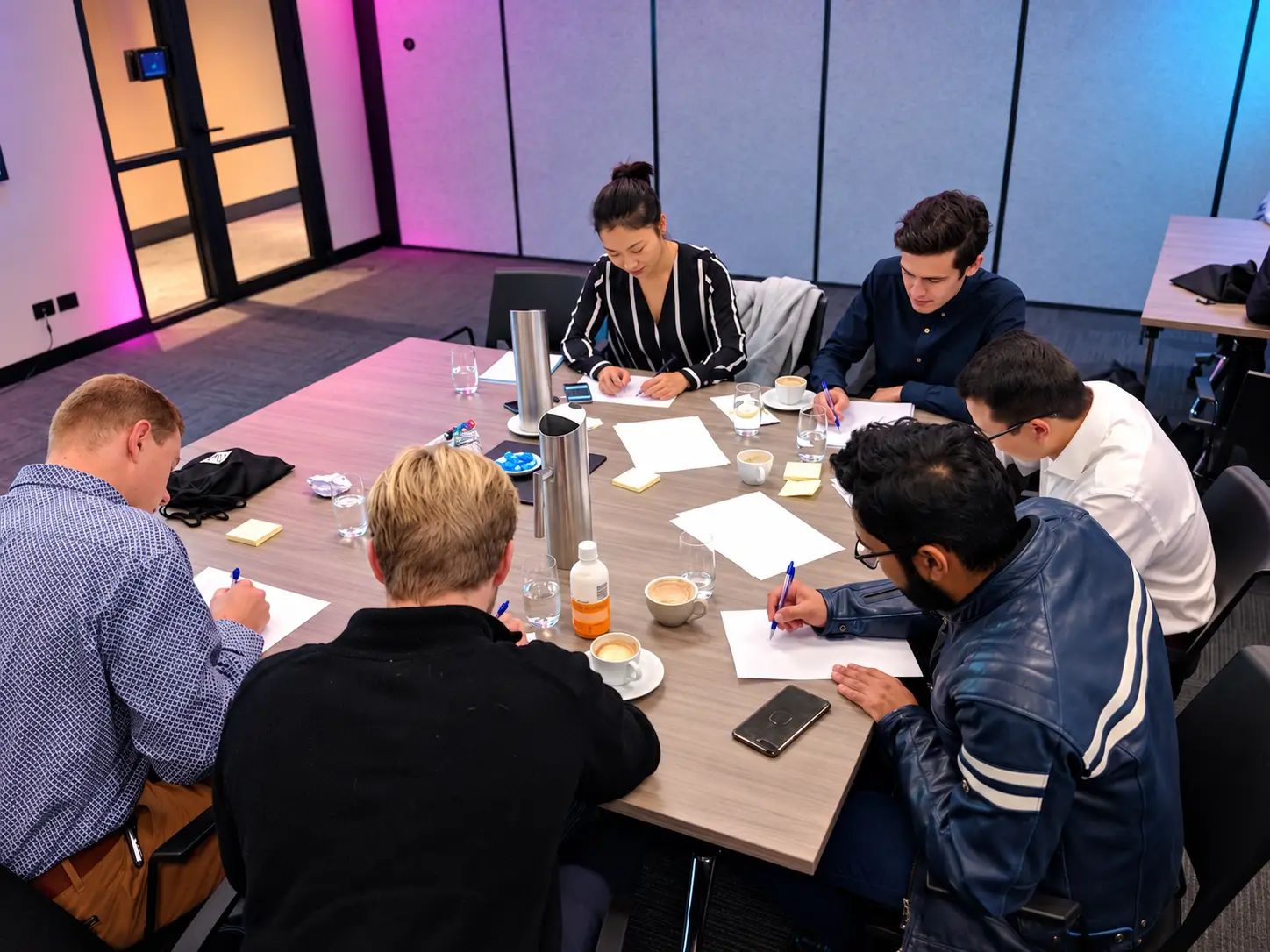
Governance training shows the decision rights.
- What is the use, in one sentence a director can repeat?
- Whose outcome does it touch: a customer, a member, an employee, or a critical operation?
- What data goes in, and who can stop the use?
- When will the board look again?
The same tool can create different risks depending on the use. Drafting a marketing email is a different use from assessing job applications.
Directors' duties and section 180
Section 180 of the Corporations Act 2001 sits in the division on general duties. The heading in the compilation is care and diligence, civil obligation only. The latest compilation on the Federal Register of Legislation, register id C2026C00432, started on 19 September 2026.
Section 180(1) says a director or other officer must exercise their powers and discharge their duties with the degree of care and diligence that a reasonable person would exercise if they were a director or officer of a corporation in the corporation's circumstances, and occupied the office held by, and had the same responsibilities within the corporation as, the director or officer. The note to the subsection records that it is a civil penalty provision. See section 1317E.
The section does not mention artificial intelligence. Deploying a model, banning a tool, or leaving a tool in place without a rule can still be an exercise of the role. The question is how the person informed themselves and how they supervised the matter.
Officers are wider than the board. The simplified outline includes some people who manage the corporation or its property, as well as directors and secretaries. Definitions sit in sections 9AC and 9AD.
Section 181(1) is the neighbouring civil duty: good faith in the best interests of the corporation, and a proper purpose. This page does not walk through the criminal offences in section 184.
The business judgment rule
Section 180(2) is the business judgment rule. A director or other officer who makes a business judgment is taken to meet the requirements of subsection (1), and their equivalent duties at common law and in equity, in respect of the judgment if they meet four conditions.
- They make the judgment in good faith for a proper purpose.
- They do not have a material personal interest in the subject matter of the judgment.
- They inform themselves about the subject matter to the extent they reasonably believe to be appropriate.
- They rationally believe that the judgment is in the best interests of the corporation.
The belief is rational unless no reasonable person in that position would hold it. The rule operates for section 180 and the equivalent duties at common law and in equity. It does not operate for other provisions of the Act.
Section 180(3) defines a business judgment as any decision to take or not take action on a matter relevant to the business operations. Adopting a tool and refusing one can both qualify. The record should show the use, the data, who is affected, the testing, the exit rights, and who stays accountable. A personal interest in a vendor is declared in the ordinary way.
What the AICD has published
The Australian Institute of Company Directors, with the Human Technology Institute at UTS, publishes A Director's Guide to AI Governance. The Version 2 page is dated 29 June 2026 and names agentic AI as a further shift toward automation.
The page puts opportunity and risk together: productivity and better decisions, and also cyber security, data governance, and the human impact on employees, customers and other stakeholders. The board's role is to govern that balance.
The same page lists a SME and NFP summary and checklist. This page does not summarise the full guide. Use the public page as a prompt, then open the organisation's own register.
APRA CPS 230 and the board
CPS 230 Operational Risk Management came into force on 1 July 2025 for banks, insurers and superannuation funds. Targeted amendments, described by APRA on 30 April 2026, commence on 1 July 2026. Check a 2025 board paper against that amended text.
It applies to ADIs, general and life insurers, private health insurers and RSE licensees, in the forms the standard lists. For a foreign ADI, a Category C insurer and an eligible foreign life company, the obligations apply to the Australian branch. The approach must fit the entity's size, business mix and complexity.
What the board must do
The board is ultimately accountable for oversight of operational risk, including business continuity and service providers. For an RSE licensee that can mean the group of individual trustees. For a foreign ADI it means the senior officer outside Australia.
- Set clear roles for senior managers on operational risk, business continuity and service provider arrangements.
- Oversee operational risk management and the key controls that keep the risk profile within appetite.
- Receive regular updates, and see that senior management acts on areas of concern.
- Approve the business continuity plan and the tolerance levels for disruptions to critical operations, review test results, and oversee the findings.
- Approve the service provider management policy and review risk and performance reporting on material service providers.
Senior management must tell the board the expected impact on critical operations when a decision could affect resilience. If an AI platform sits under payments, claims, member administration or customer enquiries, management should say what happens if the service fails, degrades or cannot be exited.
Critical operations and service providers
Operational risk here includes legal, regulatory, compliance, conduct, technology, data and change management risk. The standard does not say artificial intelligence. It does require an assessment of new products, services, geographies and technologies. A material operational risk incident must be notified to APRA as soon as possible and not later than 72 hours. An incident already notified under CPS 234 is not notified again under this clock.
Critical operations, if disrupted beyond tolerance, would materially harm customers or the entity's role in the financial system. Unless the entity can justify otherwise, minimum lists include payments for an ADI, claims for an insurer, fund administration for an RSE licensee, and customer enquiries for every APRA-regulated entity.
For each critical operation the board approves tolerance levels: the maximum time of disruption, the maximum data loss, and the minimum service levels under alternative arrangements. If an AI service helps deliver that operation, someone has to say whether the tolerance can be met without it. A disruption outside tolerance must be notified to APRA as soon as possible, and not later than 24 hours after.
A material service provider is relied on for a critical operation or exposes the entity to material operational risk. A model host or sub-processor can fall inside that policy. The April 2026 amendments allow limited contract exemptions. Ask which arrangements are exempt. The word AI does not decide materiality.
APRA CPS 234 and information security
CPS 234 Information Security makes the board ultimately responsible for information security commensurate with the threats to the entity's information assets. The same reading notes apply for an RSE licensee and a foreign ADI.
The entity must classify its information assets, including those managed by related parties and third parties, by criticality and sensitivity. The classification must reflect the degree to which an information security incident affecting the asset could affect, financially or non-financially, the entity or the interests of depositors, policyholders, beneficiaries or other customers.
A prompt store, a retrieval index of member files, a call transcription, or a model trained on customer complaints is an information asset or sits on one. If a third party manages it, the classification duty still names it. The standard does not use the words artificial intelligence. The duty is written as assets, controls, testing and notification.
- Notify APRA as soon as possible, and no later than 72 hours, after becoming aware of an information security incident that materially affected, or had the potential to materially affect, the entity or its customers, or that has been notified to another regulator.
- Notify APRA as soon as possible, and no later than 10 business days, after becoming aware of a material information security control weakness which the entity expects it will not remediate in a timely manner.
A leadership team should be able to say who starts the 72-hour clock, who decides materiality, and how the board hears about it. Those are operating facts. They belong in the incident plan, and the board should know the plan exists.
Where the standards meet a use
A claims assistant at an insurer, or a member-enquiry assistant at a superannuation trustee, can sit on a minimum critical operation. CPS 230 then asks for tolerance, a continuity path, and whether the provider is material. CPS 234 asks whether the transcripts and decision logs are classified, tested, and covered by the notification clocks.
A drafting tool in a finance team can still be a technology and data risk, and an information asset if the note holds customer data, without being a critical operation. Give every use the same rating and people stop reading the rating. A private company can borrow the questions, and should say the standard does not bind it.
How the public sources compare
Boards hear these names in one breath. They do not do the same job. The table is a reading aid. The live page of each source is the text to quote in a board paper.
| Source | Who it covers | What a board is asked to hold |
|---|---|---|
| Section 180, Corporations Act 2001 | Directors and other officers of a corporation | Care and diligence of a reasonable person in that corporation, that office and those responsibilities |
| APRA CPS 230 | APRA-regulated entities | Oversight of operational risk, business continuity and material service providers |
| APRA CPS 234 | APRA-regulated entities | Information security of information assets, including assets a related party or a third party manages |
| Voluntary AI Safety Standard | Voluntary guidance for industry | Ten guardrails, still published, aligned on that page with ISO/IEC 42001:2023 and the NIST AI Risk Management Framework 1.0 |
| Guidance for AI Adoption | Voluntary guidance for industry | Six essential practices, published on 21 October 2025 as an evolution of the Voluntary AI Safety Standard |
Six essential practices
On 21 October 2025 the Department of Industry, Science and Resources published the Guidance for AI Adoption. The Voluntary AI Safety Standard page says the guidance outlines six essential practices for safe and responsible AI governance, and that this updated and simplified guidance for industry evolves the Voluntary AI Safety Standard. The foundations page is the starting agenda. The implementation guidance is where management goes when a use is no longer small.
The foundations page is for teams starting out, using AI in lower-risk ways, or new to AI governance. Mature or higher-risk uses belong in the implementation guidance. Some practices apply across the organisation, such as a policy. Others apply to one use. The foundations PDF is marked published 5 May 2026. A board pack should say which page it quoted.
1. Decide who is accountable
The organisation is accountable for how and where AI is used. Getting started means one senior owner with authority over all AI use, and a policy that tells staff how AI will be used and how the risks are managed.
- Name the overall owner, and say what that person can stop before the next board meeting.
- Name who inside the organisation speaks to the vendor when a shared system fails.
Saying the vendor owns the model does not map accountability. The organisation remains accountable for the use.
2. Understand impacts and plan accordingly
Impacts scale with the system. A biased hiring shortlist can reject many qualified people before anyone notices. Getting started means an impact assessment, with attention to vulnerable people, and a channel to challenge an outcome that matches the seriousness of the harm.
Ask which uses can change a job, credit, claim, benefit, grade or access to a service, and where that person challenges the outcome. An email to the vendor is not the organisation's channel.
3. Measure and manage risks
Risk follows the use, not only the software update. A watched chatbot on simple questions is a different use from the same chatbot running unattended on harder ones. Screen each use as refused, allowed with conditions, or allowed and watched.
Conditions are concrete: data that must stay out, a person who reviews the output, or a ban on a fully automated denial. Name the misuse, not only the intended use.
Join the screen to the risk register the board already sees. A side spreadsheet the risk committee never opens is not a control.
4. Share essential information
People should know when they are interacting with AI and when an AI decision affects them. A customer using a chatbot should be told they are not speaking with a human specialist. Getting started means a register of systems built inside the organisation and systems bought in, including AI embedded in human resources and customer tools.
Directors need the use, the owner, the risk, the data class and the review date. Operators need the tool, the step, the disclosure line and the override. If staff are told to use the assistant and customers are not told, write that choice down.
5. Test and monitor
A system that answered well last month can answer differently after new training data. Ask the supplier for proof, test the intended use before deployment, and monitor afterwards. Extend data and cyber security practice to the system.
A supplier's proof is a starting document. Test the real task, on the data class the policy allows, with a person who can see a bad answer. Uptime monitoring will miss a model that is up and wrong.
6. Maintain human control
Oversight should match autonomy and stakes: automated monitoring on low-stakes uses, and a human review on high-stakes decisions, with a way to pause, override or shut the system down.
For the highest-stakes use, write when a person sees the output, what they can reject, and how the work continues if the system is off. A board should know whether any current use can send, pay, deny or change a record without a person in the path.
The ten guardrails
The ten guardrails remain published: accountability, risk management, data protection, testing, human control, disclosure, a way to challenge outcomes, supply-chain transparency, records, and stakeholder engagement. That page says they align with ISO/IEC 42001:2023 and the NIST AI Risk Management Framework 1.0.
Use the six practices as the agenda a leadership team can finish, and the ten guardrails when a use is higher risk, shared with another organisation, or likely to be shown to a regulator. The Department describes the six practices as an evolution and a simplification. Alignment with ISO/IEC 42001 on a government page is not a certificate.
Privacy and the OAIC guidance
The OAIC published Guidance on privacy and commercially available AI products on 21 October 2024 and updated it on 17 January 2025. It covers deployers, including internal use. The Privacy Act applies where personal information is involved.
Read it with the Privacy Act 1988 and the Australian Privacy Principles guidelines. A board session should be able to repeat these points.
- Personal information put into an AI system is still personal information, and so is output that contains personal information, including inferred or artificially generated information about an identifiable person.
- Before adopting a commercial product, do due diligence on the intended use, testing, human oversight, privacy and security risks, and who will have access to personal information the organisation inputs or generates.
- Privacy policies and notices should describe the AI use in clear language. Public-facing tools such as chatbots should be identifiable as such.
- If a system generates or infers personal information, that is a collection under Australian Privacy Principle 3. It must be reasonably necessary and done by lawful and fair means.
- Australian Privacy Principle 6 limits use and disclosure to the primary purpose unless the individual consents or a permitted secondary use is made out. Given the risks, a secondary AI purpose can be hard to bring within reasonable expectations. Where it cannot, the OAIC says to seek consent and offer a meaningful opt-out.
- As a matter of best practice, the OAIC recommends that organisations do not enter personal information, and particularly sensitive information, into publicly available generative AI tools.
- Australian Privacy Principle 10 requires reasonable steps to keep personal information accurate. The use of AI for decisions that may have a legal or similarly significant effect on a person's rights is likely to be a high privacy risk activity.
Sensitive information generally needs consent, and notice alone does not imply consent. Write an acceptable-use rule that matches the privacy policy: approved systems, data that stays out of a public tool, and when a person checks an output.
What the session should cover
AI governance training for leadership teams in Australia should be a working session on the organisation's own uses, not a tour of the global policy debate. The people in the room are the ones who can change a rule after the session. If they cannot, the session is a briefing and should be labelled as a briefing.
A session in Sydney uses the same public sources as a session in any other Australian city. If the room sets rules for people elsewhere, or for offshore suppliers, the register should name the process and where the data is handled.
- The duty map: section 180(1), the information limb of the business judgment rule, and section 181, plus the facts a paper must contain before a use is approved.
- The standards map, where it applies: critical operations, material providers, notification clocks, and how third-party information assets are classified.
- The six practices, the privacy rule, one misuse case, the human control on the highest-stakes use, and the one-page board report.
What the session should leave behind
A leadership team should be able to find these the next morning. They are the National AI Centre's getting-started actions, the OAIC's call for procedures, and, where they apply, the papers CPS 230 and CPS 234 already expect.

- An AI policy that names the overall owner, which uses need approval, and where the register lives.
- Acceptable use rules in the language of a task: which tools are approved, what must not be entered into a public tool, what a person must check, and who to ask when the rule does not fit.
- Named owners. One senior leader owns AI governance. Each system has a named person. A committee can advise. A committee is a poor substitute for a name.
- A governance framework the organisation will actually run. For a smaller organisation that may be the policy, the register and a review date. For a larger one it should meet the risk framework, internal audit and the board report that already exist.
- A register of uses and risks, including embedded tools. Each line carries the purpose, the owner, the data class, the impact, the screen outcome, the control and the review date.
- A stakeholder impact note and a contestability path for uses that affect people in a serious way. Hiring, credit, claims, benefits, grading and access to essential services come first.
- A testing and monitoring note for any use that will run on real customers, members or staff, and a human-control note for the highest-stakes use, including the off path.
- A board or executive review date, with the report template attached. The first review asks whether the policy is findable, whether new tools appeared without a line on the register, and whether any incident was escalated the way the clocks require.
Questions for the next board pack
A board can ask these before it approves a use, renews a contract, or accepts a paper that says the vendor is a leader. The questions are the public sources, applied to one named use. They are not a legal opinion.
- What is the use, and which customer, member, employee or critical operation does it change?
- What data goes in, and is any of it personal or sensitive?
- Who inside the organisation can stop the use, and what do they stop: the output, the send, the payment, the denial, or the record?
- If the organisation is APRA-regulated, does this use sit under a critical operation, and is the provider material?
- How are the information assets classified, including assets a third party holds, and who starts the 72-hour clock?
- What did management test on the organisation's own task, and what will be watched after go-live?
- How does a person affected by the outcome challenge it, and who can correct it?
- What will directors see next time, and what decision will they be asked to make if the register has not moved?
Related notes: AI governance training for leaders, how a board chooses an AI governance workshop, and what a board should write down before the AI day ends.
Run the work with Collective Campus
Collective Campus has been running capability building programs for organisations across the globe since 2015. AI governance sits alongside design thinking, customer experience, agile, lean startup, productivity, psychological safety and critical thinking. Teams still need judgment, customer understanding and a way to test an idea. Governance sets which AI uses are allowed while they do that work.
Boards, executive teams and risk teams can run the work through AI Governance for Boards, Executives and Risk. That program is built to leave a policy, acceptable use rules, named owners and a governance framework. Staff and teams who need to practise everyday use, including what can go into a tool and when to check an output, can run the AI governance workshop. The leadership session writes the rules. The staff session is how those rules meet the work.
Settle the owners and the rules with the people who can approve them, then practise the rules with the people who use the tools. Bring the unapproved uses, the privacy officer, and the executive who will be the named owner. Leave with the policy started, the register started, and a date the board will see both.
Questions boards ask
What is AI governance training for boards in Australia?
It is a working session on the AI uses the organisation already has, the duties and standards that apply, and the decisions only the board can make. A useful session names an owner, records the uses that can affect customers, staff or critical operations, and agrees what the board will see next. Legal advice has to come from the organisation's own lawyers.
Who should be in the room?
The people who can approve a use, stop a use, and explain it to the board: usually the chief executive or a delegate, the executive who owns the customer outcome, and the leaders who already carry risk, legal, privacy, technology and people obligations. The session fails when the people who can sign are absent.
How does section 180 relate to an AI decision?
Section 180 requires a director or other officer to exercise care and diligence as a reasonable person would in that corporation, that office and those responsibilities. The section does not name artificial intelligence. Care is about how they informed themselves and how they supervised the matter. This page does not predict how a court would decide a case.
What does CPS 230 ask of a board?
The board of an APRA-regulated entity is accountable for oversight of operational risk, including business continuity and service providers. It approves the continuity plan, the tolerance levels and the service provider policy. A private company is not bound merely because a customer is regulated.
When does CPS 234 matter for an AI tool?
It matters when an AI tool stores, processes or depends on an information asset of an APRA-regulated entity, including an asset a third party manages. Assets are classified, controlled and tested. A material incident has a 72-hour notification clock. A material control weakness the entity expects it will not fix in a timely way has a clock of 10 business days.
What are the six essential practices?
Decide who is accountable, understand impacts and plan accordingly, measure and manage risks, share essential information, test and monitor, and maintain human control. The Department published this guidance on 21 October 2025 as an evolution of the Voluntary AI Safety Standard. The practices do not replace the Corporations Act, the Privacy Act or an APRA standard.
Is this legal advice?
No. This page is general information about public Australian sources. Advice on how a regulator or a court would treat a particular organisation has to come from that organisation's own counsel. Ask counsel how section 180, the Privacy Act and any APRA standard apply to the uses on the register.
How can a board run this with Collective Campus?
Collective Campus has been running capability building programs for organisations across the globe since 2015, including design thinking, customer experience, agile, lean startup, productivity and AI. Boards can use AI Governance for Boards, Executives and Risk. Staff can practise the rules in the AI governance workshop.
General information
This page is general information for Australian boards, executives and leadership teams. Legal, prudential and privacy advice has to come from the organisation's own lawyers and advisers, including how the Corporations Act, the Privacy Act, any APRA standard that applies, and the National AI Centre's guidance fit the uses that organisation actually runs.